Sunday, 8 February 2015

Dilution is very real

GMO published its quarterly letter, which is always interesting to read.

Regarding the issue of dilution (also in relation with my previous posting), GMO wrote the following regarding the relationship between GDP growth and EPS growth for a nation:


I am sure the above holds true for many Bursa listed companies as well.

Some will boast about their increase in market cap, while a lot of that was funded by rights issues, private placements and acquisitions paid for by issuing new shares while hardly paying any dividends.

Next to that there will be rather quiet (one could say: boring) companies, where market cap has grown less spectacular, but where no new shares were issued while paying out generous dividends.

Lay Hong: large private placement and substantial share issue scheme

Regular readers of this blog will know that I am not a fan of private placements (PP).

If a company really needs money then a rights issue is much more fair, all investors will have the opportunity to participate, and those we don't want to can sell their rights in the market.

When a company's major shareholders are engaged in a battle for control and the company announces a PP, then alarm bells should go off.

Lay Hong is such a company, which announced a large private placement, combined with a substantial SIS (Share Issue Scheme).

I am also not a fan of SIS or ESOS either, I would prefer a system where employees receive a bonus for hitting some long term targets. That seems much more transparent (for shareholders) and fair (for employees).

"Serious Investing" wrote a good article about the Lay Hong private placement.

MSWG wrote the following in their newsletter of February 6, 2015:


MSWG has a very valid point, Lay Hong's earnings track record is not that great, can it really increase earnings by such an amount that the dilution caused by the PP and the SIS will be offset?

From it's last year report:


Friday, 6 February 2015

SGX issues

"Remisiers write to Tharman to resolve issues plaguing market"

Article in the Business Times (Singapore) of February 5, 2015.

Some snippets:

The issues raised and remedies proposed include separating Singapore Exchange's regulatory and commercial roles, raising the public portion of an IPO, restoring investors' trust in the local bourse, reviewing onerous rules for "high-risk" products, and listing of government-linked companies such as PSA and Changi Airports International to add breadth and depth to the market.

...some of the key recommendations contained in the letter were:
  • issuing at least 25 per cent of shares in an IPO to the public; this would avoid the farce of initial public offerings turning into initial private offerings;
  • better rules for short selling disclosure;
  • rethinking regulations for sophisticated instruments;
  • setting up truly independent committees when consulting the public on proposed policy changes;
  • raising the quality bar for CPF Trustee stocks and lifting the limit for investment in equities from 35 to 80 per cent of the CPF Ordinary Account;
  • transferring long-suspended stocks with governance issues to a high-risk third board with cash upfront trading;
  • providing the market with regular updates on investigations such as the current probe into the October 2013 crash of LionGold, Blumont and Asiasons;
  • separating SGX's regulatory and commercial roles.
 
I have written about quite a few of the above issues, for instance "Listing panel lacks investors", the lack of public shares in an IPO and separating regulatory and commercial roles of SGX (or Bursa for that matter).
 
The response came one day later:

"SGX and SIAS respond to remisiers' grouses"

Some snippets:


SGX said: "We actively engage market participants, relevant stakeholders and the public prior to introducing any new initiatives to the marketplace through public consultations. Initiatives are then introduced after approval from our regulators." It mentioned the recent reduction of the board lot size from 1,000 to 100 as an example of the result of such a public consultation.


To me, reducing the lot size without reducing the cost doesn't make sense at all, I wrote before about this subject: "High cost for small transactions on Bursa".


On other fronts, Mr Gerald agreed that better rules for short selling disclosures and a review on regulations for sophisticated instruments are needed. He concurred, too, that the market should be given regular updates on on-going investigations and that the SGX's commercial and regulatory roles should be separated. Some of these are already under review, he said.


Another article from the Straits Times (February 6, 2015):

"Prospectuses should be in plain English"

Some snippets:


SINGAPORE'S financial regulator has rolled out a set of proposals aimed at fixing a problem that has long plagued the financial industry - bad writing.

The Monetary Authority of Singapore (MAS) wants issuers of financial products to write their prospectuses in plain English, not jargon-laden gibberish.

It is urging them to present information in a clear, concise and logical manner and avoid unnecessarily lengthy sentences.

A prospectus is meant to contain all the information investors and their advisers would need to make an informed investment decision about a financial product.

However, "in recent years, MAS has observed that prospectuses have grown in length and are often drafted in a technical, convoluted or legalistic manner", the regulator noted.

"As a result, even though prospectuses may contain comprehensive disclosures, investors often find them difficult to read and understand."

Many prospectuses are long and repetitive, include unnecessary or irrelevant details and use financial or technical jargon to conceal important information, the MAS added.

They also employ vague disclosures that may not be meaningful to investors, use convoluted descriptions or explanations and include lengthy and difficult-to-understand terms and conditions.


I completely agree with this, and have written several times about the long, hardly readable brochures of IPO listings on Bursa, for instance here.

Thursday, 5 February 2015

Long-term investors should know about short selling skills

Great article by "ContrarianValue Edge":

"What Long Term Investors Can and SHOULD LEARN From Short Sellers"

Some snippets:


Let me make it clear at the outset that I had never done short selling nor do I plan to do in future. But I found principles of short selling technique to be equally helpful to long-term investors. For short sellers the maximum upside is 100% whereas downside is unlimited. These asymmetrical returns force short sellers to be much more diligent and conservative compared to long only investors. I was surprised to note that most successful short sellers never short any stock merely on over-valuation. I am not talking here about short sellers who short a stock in the morning and cover their position by the end of the day.  I am talking about short sellers, who after deep analysis create a position and hold on to it until their conviction pays off.

Charlie Munger once said, ‘All I ever want to know is where I’m going to die, so I never go there’. My sole attempt at studying short selling technique is to find what successful short sellers look for in a good short and to avoid such stocks.

Successful short sellers look for the following before they decide to short any stock:
  • Business : Secular problems or fundamental change in the nature of business.
  • People: Dishonest and incompetent management.
  • Balance Sheet: Higher leverage is preferred.
  • Profit & Loss account: Quality & Sustainability of earnings. Simple overstatement of earnings is not enough. Short sellers are looking for cases where  economic reality is significantly divorced from the accounting presentation of the business.
  • Price: Valuation is given least preference by most short sellers.

Many interesting links are also to be found in the above article.

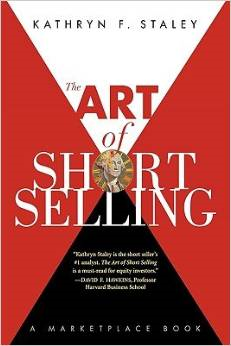
A good (albeit almost 20 years old) book is "The Art of Short Selling" by Kathryn Staley: