From kehakiman's website regarding CNLT (Far East) Bhd, a company formerly listed on Bursa:
11. The Employees’ complaint of fraudulent trading straddled 8 allegations of fact that allegedly occurred between 2006 and 2008. They were as follows:
(a) CNLT, primarily through its managing director, the Appellant, prepared or issued fictitious invoices in 2007 to an entity known as MTI (Far East) Sdn Bhd amounting to RM4,271,745.06 with a view to inflating or overstating its revenue, such that CNLT would appear to be a ‘going concern’, or at the very least, not as insolvent as it actually was;
(b) Overstating the value of the plant and machinery of CNLT;
(c) Siphoning of CNLT’s funds by way of payment of rental to Golden Privilege Sdn Bhd when there was no such tenancy agreement. This company was controlled by the Appellant and the 7th defendant;
(d) CNLT’s assets in the sum of USD1,250,000 were dissipated or channelled to CNLT’s largest shareholder, JCT Limited, the 8th defendant after CNLT had been listed as a PN17 company;
(e) CNLT, through inter alia, the Appellant caused 3 cheques in the sum of RM160,000.00 to be issued on 11 September 2007. These cheques were encashed on 12 September 2007;
(f) Failure to cause CNLT to remit contribution to Employees Provident Fund (“EPF”) and Social Security Organization (SOCSO), both employer and employee despite deducting the requisite employee contribution since August 2007. Neither was income tax paid, despite the requisite deductions having been made;
(g) The Appellant’s action in dissipating assets out of the reach of provisional liquidators in May 2008; and
(h) Payments were made out to preferred unsecured creditors, as well as some shareholders in the sum of not less than RM2,841,696.00 without validation at the time the restraining order dated 26.10.2007 was in force.
12. It was the Employees’ case that by reason of the foregoing matters the business of CNLT was carried on from 2006 onwards until it was wound up in January 2009 with intent to defraud creditors of the company, or for a fraudulent purpose. For the purpose of the application of section 304 of the Act in this suit the creditors contemplated here were the Employees.
13. By this action, the Employees sought inter alia the following orders:
(a) a declaration that the business of CNLT had been carried on by the defendants with intent to defraud creditors of CNLT, in particular the Employees pursuant to section 304 of the Act;
(b) a declaration that the defendants shall be jointly and/or severally liable and personally responsible, without any limitation of liability for all of the debts or other liabilities of CNLT; and
(c) an order that the defendants, jointly and/or severally do pay the outstanding debt due and owing to the Employees by CNLT.
Very heavy accusations, and what did the judge decide?
18. At the end of the trial, the learned trial judge held that the Employees had proved 7 out of 8 allegations. It was held that allegation (c), the siphoning of CNLT’s funds by way of payment of rental to Golden Privelege Sdn Bhd, was not made out. The learned trial judge found that payments to JCT limited were void as they were against the law prohibiting undue preference.
19. The learned trial judge accordingly held that the business of CNLT was carried on by the Appellant with intent to defraud the creditors of CNLT including the Employees pursuant to section 304 of the Act. A declaration was made to that effect by the court. There was however no such declaration granted in respect of the other directors of CNLT. The court also held that the Appellant was personally liable to the Employees, to pay the Employees the sum of RM2,910,201.78 as claimed with interest.
Most of the proven allegations happened more than ten years ago.
A forensic report was made, with many observations similar to the above. The company however denied all in an announcement to Bursa. Since the judge held that seven allegations have been proved, the truthfulness of the contents of that announcement should be reviewed.
The above court case was a private affair by the employees who were disadvantaged. It seems they are winning their case, good for them, it must have been a quite costly and lengthy affair.
But what have the authorities done so far, for instance in regards to the minority investors who have been disadvantaged? From what I could find, not much.
Bursa reprimanded the company (I don't think anybody will be bothered by that) and delisted it (basically disadvantaging the minority investors by depriving them an opportunity to trade their shares). No action whatsoever was taken against any individual.
SSM obtained a conviction: "The Kuala Lumpur Sessions court today convicted Dato’ Prem Krishna Sahgal (‘Dato’ Prem’) for committing an offence under section 364 (2) of the Companies Act 1965. Dato’ Prem was sentenced to pay a fine of RM40,000.00 in default 6 months imprisonment."
It continues "SSM hopes the above decision will send out a clear message". I doubt that, I find the punishment very light, especially given the small chance of getting caught.
Where is the enforcement for any of the other (very serious) allegations, why have Bursa and/or SC still not taken any action in this matter?
Justice delayed is justice denied.
Showing posts with label Bursa Malaysia. Show all posts
Showing posts with label Bursa Malaysia. Show all posts
Monday, 16 October 2017


Wednesday, 13 September 2017
Raising the bar for SGX delistings
Article in The Straits Times, some snippets:
For a company to be voluntarily delisted, a shareholders' meeting must be held where approval for the move must be received from 75 per cent of the shareholders present and where not more than 10 per cent disagree with the move.
The snag is that this feat is made easier because the listing rules here do not bar directors and major shareholders from voting - and since the major shareholder, usually also the company boss, is the party proposing the delisting move, the odds are stacked heavily against minority shareholders.
In recent years, however, some companies are being taken private at a very low valuation at the bottom of the business cycle, only to be relisted in another jurisdiction at a much higher valuation.
No wonder, some minority shareholders feel existing listing rules fail to give them adequate protection if an opportunistic major shareholder wants to delist the company and attempt to squeeze them out of their shares at unattractive prices.
..... the academics observed that there had been instances of IFAs assessing offers as being "fair and reasonable" even when the exit offer in question was at a steep discount of more than 30 per cent to the latest NAV of the takeover target.
Against this backdrop, I would say that the SGX listing manual is due for an overhaul.
Delistings have become a red-button issue among aggrieved minority shareholders. It is one area that urgently needs to be looked into when the rule book is revamped.
For a company to be voluntarily delisted, a shareholders' meeting must be held where approval for the move must be received from 75 per cent of the shareholders present and where not more than 10 per cent disagree with the move.
The snag is that this feat is made easier because the listing rules here do not bar directors and major shareholders from voting - and since the major shareholder, usually also the company boss, is the party proposing the delisting move, the odds are stacked heavily against minority shareholders.
In recent years, however, some companies are being taken private at a very low valuation at the bottom of the business cycle, only to be relisted in another jurisdiction at a much higher valuation.
No wonder, some minority shareholders feel existing listing rules fail to give them adequate protection if an opportunistic major shareholder wants to delist the company and attempt to squeeze them out of their shares at unattractive prices.
..... the academics observed that there had been instances of IFAs assessing offers as being "fair and reasonable" even when the exit offer in question was at a steep discount of more than 30 per cent to the latest NAV of the takeover target.
Against this backdrop, I would say that the SGX listing manual is due for an overhaul.
Delistings have become a red-button issue among aggrieved minority shareholders. It is one area that urgently needs to be looked into when the rule book is revamped.
The same applies to Bursa, a revamp is needed in which minority investors receive more protection from delistings at a very low price, it is long overdue.
Thursday, 31 August 2017
Late "strong pick-up" by Bursa
Article from The Star, one snippet (emphasis mine):
Bursa Malaysia staged a late strong pick-up before closing, led by gains in selected blue chips such as CIMB Group Bhd, Axiata Group Bhd and MISC Bhd.
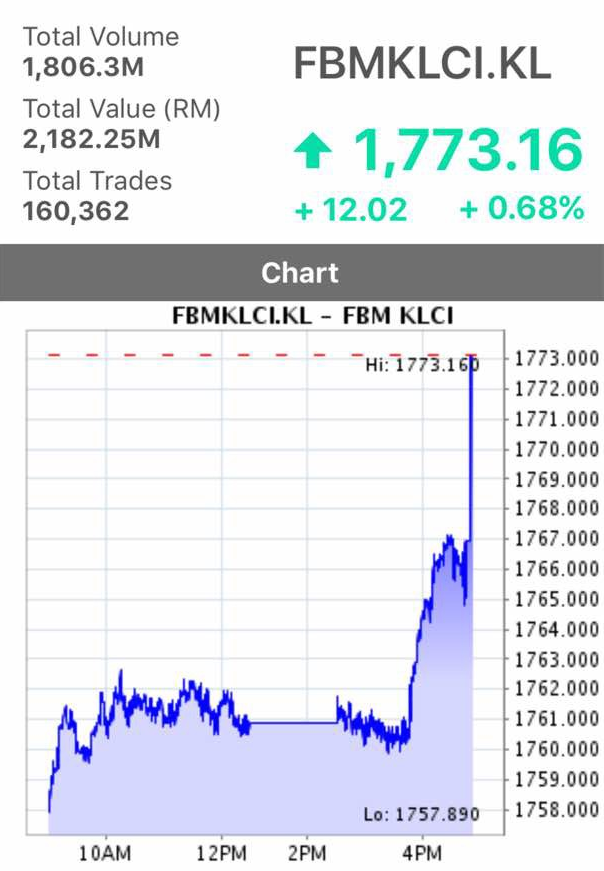
The benchmark FTSE Bursa Malaysia KL Composite Index (FBM KLCI) closed 12 points higher to 1,773.16 yesterday, after a slow start to the week.
Inter-Pacific Securities Sdn Bhd head of research Pong Teng Siew said foreign investors were net sellers yesterday despite the strong pick-up in the FBM KLCI.
“It was a last-minute push before the long holiday, and it was quite unusual considering the results season is still ongoing,” he told StarBiz.
It was definitely unusual, let's zoom in on a few counters.
On 16:50:01 it was CIMB's turn, a sudden 32 cent jump in price:


And one second later at 16:50:04 Timecom's turn, a 53 cent jump in price:

As a consequence, a sudden spike in the KLCI:

Bursa Malaysia staged a late strong pick-up before closing, led by gains in selected blue chips such as CIMB Group Bhd, Axiata Group Bhd and MISC Bhd.
The benchmark FTSE Bursa Malaysia KL Composite Index (FBM KLCI) closed 12 points higher to 1,773.16 yesterday, after a slow start to the week.
Inter-Pacific Securities Sdn Bhd head of research Pong Teng Siew said foreign investors were net sellers yesterday despite the strong pick-up in the FBM KLCI.
“It was a last-minute push before the long holiday, and it was quite unusual considering the results season is still ongoing,” he told StarBiz.
It was definitely unusual, let's zoom in on a few counters.
On 16:50:01 it was CIMB's turn, a sudden 32 cent jump in price:

Two seconds later UMW's turn, a 45 cent jump:


As a consequence, a sudden spike in the KLCI:
Who was (were) the buyer(s), may be a fund that needed to show good results at the last trading day of August?
It looks all very artificial, is this actually allowed, will SC take action?
Saturday, 12 August 2017
Dual class shares: another really bad idea (3)
Bursa announced the following rather terse media release:
There have been some misleading reports of late which have caused confusion on Bursa Malaysia’s position on the listing of dual class shares. Bursa Malaysia’s position has been misunderstood and taken out of context. We wish to inform that presently, we have no plan to facilitate the listing of dual class shares. In Bursa Malaysia’s pursuit to remain attractive and competitive, we are committed to uphold market integrity and ensure sound investor protection in all our market development initiatives.
One could deduct (although it is not written explicitedly) that facilitating dual shares might help Bursa to remain attractive and competitive, but would weaken market integrity and investor protection.
There have been some misleading reports of late which have caused confusion on Bursa Malaysia’s position on the listing of dual class shares. Bursa Malaysia’s position has been misunderstood and taken out of context. We wish to inform that presently, we have no plan to facilitate the listing of dual class shares. In Bursa Malaysia’s pursuit to remain attractive and competitive, we are committed to uphold market integrity and ensure sound investor protection in all our market development initiatives.
One could deduct (although it is not written explicitedly) that facilitating dual shares might help Bursa to remain attractive and competitive, but would weaken market integrity and investor protection.
Wednesday, 9 August 2017
Dual class shares: another really bad idea (2)
I wrote before about this subject.
It seems that Bursa is still considering to allow dual class shares in Malaysia.
Just to show one "horror" case what might happen, Alphaville wrote about the company DryShips (listed as DRYS on the NASDAQ): "Who buys DRYS?".
One snippet:
Taking into account the rapid series of share consolidations Dryships has had down the years, the stock price has fallen from $1.483bn per share to $1.40.
So what’s going on?
We first looked at this thing last month, at which point the peak-to-trough stats stood at an historical high of $206m and a low then of 99 cents. Over the past fortnight, following fresh consolidation of the shares, the price has fallen 80 per cent.
The company has a market cap of $7.26m, but (as of July 21) it held cash of $58.6m and a book value of $652m, against debt of $237m. Its fleet of tankers and drybulk vessels stands at 39.
Confused? Here’s what’s happening.
In April this year DryShips, which is registered in the Marshall Islands, struck a deal with a BVI firm, Kalani Investments, whereby Dryships would sell up to $226m worth of stock to the BVI entity over a two year period.
The deal sees Kalani getting the DryShips stock at a discount and they quickly dump the newly-issued equity on the US market. The flood of stock depresses the share price, which falls below $1 — risking suspension under Nasdaq rules. So, once a month for the past four months, DryShips has enacted share consolidations — most recently at 1-for-7 — to get the price back above a dollar.
It’s these repeated consolidations which throw up the comic historic share price high of $1.483bn when the chart is reset.
The company is controlled by a Greek shipping financier, George Economou, through super-voting stock. Many of the vessels in the DryShips fleet have been acquired from Economou’s private interests — so if you follow the money you’ll see it is flowing from US investors, by way of the Caribbean, to his family estate.
David Webb wrote again about the dual class shares "One Board, One Regulator".
Webb also mentions many other issues that are relevant to Malaysia (and Singapore), for instance:
8. Full disclosure of the identities of subscribers (including beneficial owners of 10% or more of their votes or equity) and the numbers of shares subscribed in placings, whether at initial listing or subsequently. [in the Malaysian context, a six year old blog posting Private Placements: abolish them or limit them, nothing has changed]
9. Full disclosure of the identities of beneficial owners of counterparties to notifiable transactions (acquisitions, disposals or loans) by listed companies. No more hiding behind BVI curtains. [in the Malaysian context just one example: Protasco's Puzzling Purchase, the vendor being owned by Anglo Slavic Petrogas Ltd, a BVI company]
11. INEDs: boards or shareholders can continue to nominate candidates for election as Independent Non-Executive Directors, but controlling shareholders, executive directors and their associates must abstain from voting in the elections, due to their obvious conflict of interests. This will leave independent shareholders to elect the INEDs. Otherwise, INEDs serve at the pleasure of the King, making a joke of their independence.
12. Tighten the permissible general mandate to dilute existing shareholders by issuing new shares for cash, with a maximum of 5% enlargement in any year, at a maximum discount of 5% (currently: 20% at a 20% discount). Any larger size or discount should require a rights issue, or approval by 75% of votes cast by independent shareholders on a special resolution. This would raise HK pre-emption standards to the UK's.
And regarding legislation:
1. provide investors with access to justice in the form of class action rights. The loser-pays costs system will deter vexatious or meritless cases;
It seems that Bursa is still considering to allow dual class shares in Malaysia.
Just to show one "horror" case what might happen, Alphaville wrote about the company DryShips (listed as DRYS on the NASDAQ): "Who buys DRYS?".
One snippet:
Taking into account the rapid series of share consolidations Dryships has had down the years, the stock price has fallen from $1.483bn per share to $1.40.
So what’s going on?
We first looked at this thing last month, at which point the peak-to-trough stats stood at an historical high of $206m and a low then of 99 cents. Over the past fortnight, following fresh consolidation of the shares, the price has fallen 80 per cent.
The company has a market cap of $7.26m, but (as of July 21) it held cash of $58.6m and a book value of $652m, against debt of $237m. Its fleet of tankers and drybulk vessels stands at 39.
Confused? Here’s what’s happening.
In April this year DryShips, which is registered in the Marshall Islands, struck a deal with a BVI firm, Kalani Investments, whereby Dryships would sell up to $226m worth of stock to the BVI entity over a two year period.
The deal sees Kalani getting the DryShips stock at a discount and they quickly dump the newly-issued equity on the US market. The flood of stock depresses the share price, which falls below $1 — risking suspension under Nasdaq rules. So, once a month for the past four months, DryShips has enacted share consolidations — most recently at 1-for-7 — to get the price back above a dollar.
It’s these repeated consolidations which throw up the comic historic share price high of $1.483bn when the chart is reset.
The company is controlled by a Greek shipping financier, George Economou, through super-voting stock. Many of the vessels in the DryShips fleet have been acquired from Economou’s private interests — so if you follow the money you’ll see it is flowing from US investors, by way of the Caribbean, to his family estate.
David Webb wrote again about the dual class shares "One Board, One Regulator".
Webb also mentions many other issues that are relevant to Malaysia (and Singapore), for instance:
8. Full disclosure of the identities of subscribers (including beneficial owners of 10% or more of their votes or equity) and the numbers of shares subscribed in placings, whether at initial listing or subsequently. [in the Malaysian context, a six year old blog posting Private Placements: abolish them or limit them, nothing has changed]
9. Full disclosure of the identities of beneficial owners of counterparties to notifiable transactions (acquisitions, disposals or loans) by listed companies. No more hiding behind BVI curtains. [in the Malaysian context just one example: Protasco's Puzzling Purchase, the vendor being owned by Anglo Slavic Petrogas Ltd, a BVI company]
11. INEDs: boards or shareholders can continue to nominate candidates for election as Independent Non-Executive Directors, but controlling shareholders, executive directors and their associates must abstain from voting in the elections, due to their obvious conflict of interests. This will leave independent shareholders to elect the INEDs. Otherwise, INEDs serve at the pleasure of the King, making a joke of their independence.
12. Tighten the permissible general mandate to dilute existing shareholders by issuing new shares for cash, with a maximum of 5% enlargement in any year, at a maximum discount of 5% (currently: 20% at a 20% discount). Any larger size or discount should require a rights issue, or approval by 75% of votes cast by independent shareholders on a special resolution. This would raise HK pre-emption standards to the UK's.
And regarding legislation:
1. provide investors with access to justice in the form of class action rights. The loser-pays costs system will deter vexatious or meritless cases;
Thursday, 3 August 2017
XingQuan: boardroom getting rather empty
Two more independent directors of XingQuan resigned, "Due to time commitment issue" and somewhat more specific:
As he will not be able to discharge and perform the duties and responsibilities of an independent director due to the expiry of the employment contract of the CFO in early May 2017, the resignation of Audit Committee Chairman in end of May 2017, the recent resignation of the other independent director, and the inability of the Company to secure suitable candidates to fill the aforesaid vacancies since May 2017, he therefore tender resignation as an independent director.
That means that the audit committee is now vacant, as is the department of independent directors. Any takers? If not, who will defend the rights of the minority investors?
I have warned several times about XingQuan, the first time (XingQuan: does the company believe its own cash?) almost exactly two years ago.
So far no visible action has been taken by the authorities. Did it really have to come this far? Fast, adequate action might for instance have prevented the rights issue, pouring more good money after bad. Or may be some of the assets could have been saved and liquidated, to the advantage of the minority investors.
In a unrelated case, the Securities Commission has taken action against a father and son for submitting false or misleading information. But the punishment is a mere reprimand and permanent moratorium regarding listings in Malaysia. I guess the perpetrators will simply shrug their shoulders and move on, the world outside Malaysia is pretty large after all.
The real test will be if the Malaysian authorities will be able to fine foreigners or impose a jail sentence. So far no action of that kind has ever been taken against any of the listed Chinese companies in Malaysia. Time will tell if it ever will happen.
If it turns out to be near impossible to impose these penalties, then Bursa should never have allowed foreign companies to list in Malaysia, because of the absence of any significant deterrent.
As he will not be able to discharge and perform the duties and responsibilities of an independent director due to the expiry of the employment contract of the CFO in early May 2017, the resignation of Audit Committee Chairman in end of May 2017, the recent resignation of the other independent director, and the inability of the Company to secure suitable candidates to fill the aforesaid vacancies since May 2017, he therefore tender resignation as an independent director.
That means that the audit committee is now vacant, as is the department of independent directors. Any takers? If not, who will defend the rights of the minority investors?
I have warned several times about XingQuan, the first time (XingQuan: does the company believe its own cash?) almost exactly two years ago.
So far no visible action has been taken by the authorities. Did it really have to come this far? Fast, adequate action might for instance have prevented the rights issue, pouring more good money after bad. Or may be some of the assets could have been saved and liquidated, to the advantage of the minority investors.
In a unrelated case, the Securities Commission has taken action against a father and son for submitting false or misleading information. But the punishment is a mere reprimand and permanent moratorium regarding listings in Malaysia. I guess the perpetrators will simply shrug their shoulders and move on, the world outside Malaysia is pretty large after all.
The real test will be if the Malaysian authorities will be able to fine foreigners or impose a jail sentence. So far no action of that kind has ever been taken against any of the listed Chinese companies in Malaysia. Time will tell if it ever will happen.
If it turns out to be near impossible to impose these penalties, then Bursa should never have allowed foreign companies to list in Malaysia, because of the absence of any significant deterrent.
Wednesday, 2 August 2017
Public Bank: end of an era
From The Star: Public Bank Bhd chairman Tan Sri Teh Hong Piow to retire
Some snippets:
Public Bank Bhd chairman Tan Sri Teh Hong Piow will leave his post on Jan 1, 2019 but will remain as the bank’s adviser.
“The details relating to the appointment of the new chairman of Public Bank will be announced at an appropriate time,” the bank said in a statement.
Teh will assume the title “chairman emeritus” after he relinquishes his position as chairman of Public Bank.
This, according to the bank, is in recognition of his “par excellence contributions” over the past 51 years since he founded Public Bank on Dec 30, 1965.
He would also remain as an adviser.
Teh is also retiring from his role as chairman of Public Islamic Bank Bhd and Public Investment Bank Bhd with effect from Jan 1, 2018, but would stay on as non-executive director in both wholly-owned subsidiaries of Public Bank with effect from the same day.
“The smooth transitions of the succession of the chairmanships of Public Bank, Public Islamic Bank and Public Investment Bank are in place,” the group said.
Public Bank under Teh's leadership has been one of the biggest success stories on Bursa, may be the best, but definetely in the top one percent group.
I only have data going back to 1987, over that 30-year timespan Public Bank compounded 16.4% (vs. 8.4% of the KLCI (both total return, taking dividends into account).
That means that RM 10,000 invested in Public Bank in 1987 is worth RM 1,014,000 now, while RM 10,000 invested in the KLCI is worth now RM 118,600, an outperformance of about 8.5 times.
Public Bank itself is a component of the KLCI, so relative to the other 29 counters it would have done even slightly better.
All very impressive, and one good example how much a succesful buy-and-hold strategy through an investment in a good quality company can yield. No wonder there are a lot of happy faces at the yearly AGM meetings.
Public bank has never reported a loss, not even in the horrific Asian crisis of 1997/98.
Some snippets:
Public Bank Bhd chairman Tan Sri Teh Hong Piow will leave his post on Jan 1, 2019 but will remain as the bank’s adviser.
“The details relating to the appointment of the new chairman of Public Bank will be announced at an appropriate time,” the bank said in a statement.
Teh will assume the title “chairman emeritus” after he relinquishes his position as chairman of Public Bank.
This, according to the bank, is in recognition of his “par excellence contributions” over the past 51 years since he founded Public Bank on Dec 30, 1965.
He would also remain as an adviser.
Teh is also retiring from his role as chairman of Public Islamic Bank Bhd and Public Investment Bank Bhd with effect from Jan 1, 2018, but would stay on as non-executive director in both wholly-owned subsidiaries of Public Bank with effect from the same day.
“The smooth transitions of the succession of the chairmanships of Public Bank, Public Islamic Bank and Public Investment Bank are in place,” the group said.
Public Bank under Teh's leadership has been one of the biggest success stories on Bursa, may be the best, but definetely in the top one percent group.
I only have data going back to 1987, over that 30-year timespan Public Bank compounded 16.4% (vs. 8.4% of the KLCI (both total return, taking dividends into account).
That means that RM 10,000 invested in Public Bank in 1987 is worth RM 1,014,000 now, while RM 10,000 invested in the KLCI is worth now RM 118,600, an outperformance of about 8.5 times.
Public Bank itself is a component of the KLCI, so relative to the other 29 counters it would have done even slightly better.
All very impressive, and one good example how much a succesful buy-and-hold strategy through an investment in a good quality company can yield. No wonder there are a lot of happy faces at the yearly AGM meetings.
Public bank has never reported a loss, not even in the horrific Asian crisis of 1997/98.
Tuesday, 11 July 2017
"Lotte's Chemical Reaction"
A rather negative story about Lotte Chemical Titan from Bloomberg.
Some snippets:
Lotte Group seemed to be getting back to business after a rough year of court battles, family feuds and strained relations with China.
Not so fast.
Believers in South Korea's fifth-largest conglomerate were hoping for a much-needed win with Lotte Chemical Titan Holding Bhd., the petrochemical unit that began trading in Malaysia Tuesday. Revival of the long-delayed 3.77 billion ringgit ($877 million) initial public offering, Malaysia's biggest since 2012, caps a period that has seen the group also take steps to settle family disputes and boost corporate debt sales.
But in the opposite of a typical IPO bump, shares of Lotte Chemical Titan fell below the opening price pretty much immediately -- and that was after the company cut the bottom of its price range to 6.50 ringgit a share, from 7.60 ringgit. By midday in Kuala Lumpur, the shares were down 2 percent.
Investors are right to bet against the newly listed company. The reason the Malaysian chemical maker cut its IPO price and trimmed the number of institutional shares has little to do with macro issues like equity demand and more to do with how Lotte missed a fundamental shift in the petrochemicals market.
While Lotte was hell-bent on getting the flotation done after taking the company private more than six years ago, it miscalculated in betting that the market would be willing to overlook the business's problems just because of a dearth of IPOs for large investors.
Back when Lotte took the unit private, the global economic recovery was driving strong demand for the raw materials used to make plastic and synthetic fibers used in everything from appliances to automobiles.
But as the years went on, Lotte Chemical did almost nothing to expand capacity -- unlike its global competitors -- despite having ample cash, according to Smartkarma analyst Toh Zhen Zhou.
In the absence of investment, revenue growth slowed. Lower prices for inputs such as oil have helped prop up profit but as the sales outlook for products like cars weakens, demand for Lotte's offerings has waned. Meanwhile, raw material prices have declined and overcapacity in China is further pressuring the industry.
Is this really the best Bursa can do, as alleged by Bloomberg, the largest IPO since 2012?
A foreign company, again going through the "listed-delisted-relisted scenario", and with the above history?
Where are the homegrown Malaysian companies with increasing (international) revenues, juicy margins, high ROE, making unique products protected by IP (intellectual Property)?
Some snippets:
Lotte Group seemed to be getting back to business after a rough year of court battles, family feuds and strained relations with China.
Not so fast.
Believers in South Korea's fifth-largest conglomerate were hoping for a much-needed win with Lotte Chemical Titan Holding Bhd., the petrochemical unit that began trading in Malaysia Tuesday. Revival of the long-delayed 3.77 billion ringgit ($877 million) initial public offering, Malaysia's biggest since 2012, caps a period that has seen the group also take steps to settle family disputes and boost corporate debt sales.
But in the opposite of a typical IPO bump, shares of Lotte Chemical Titan fell below the opening price pretty much immediately -- and that was after the company cut the bottom of its price range to 6.50 ringgit a share, from 7.60 ringgit. By midday in Kuala Lumpur, the shares were down 2 percent.
Investors are right to bet against the newly listed company. The reason the Malaysian chemical maker cut its IPO price and trimmed the number of institutional shares has little to do with macro issues like equity demand and more to do with how Lotte missed a fundamental shift in the petrochemicals market.
While Lotte was hell-bent on getting the flotation done after taking the company private more than six years ago, it miscalculated in betting that the market would be willing to overlook the business's problems just because of a dearth of IPOs for large investors.
Back when Lotte took the unit private, the global economic recovery was driving strong demand for the raw materials used to make plastic and synthetic fibers used in everything from appliances to automobiles.
But as the years went on, Lotte Chemical did almost nothing to expand capacity -- unlike its global competitors -- despite having ample cash, according to Smartkarma analyst Toh Zhen Zhou.
In the absence of investment, revenue growth slowed. Lower prices for inputs such as oil have helped prop up profit but as the sales outlook for products like cars weakens, demand for Lotte's offerings has waned. Meanwhile, raw material prices have declined and overcapacity in China is further pressuring the industry.
Is this really the best Bursa can do, as alleged by Bloomberg, the largest IPO since 2012?
A foreign company, again going through the "listed-delisted-relisted scenario", and with the above history?
Where are the homegrown Malaysian companies with increasing (international) revenues, juicy margins, high ROE, making unique products protected by IP (intellectual Property)?
Sunday, 25 June 2017
China government auditor detects fraud
Shocking (although not unexpected) article in The Malay Mail by Reuters: "China auditor uncovers 200b yuan in fake revenue at state firms", some snippets:
China’s government auditor said in its 2016 report published today that 18 of 20 central state firms it audited had inflated revenue by 200 billion yuan (RM125.4 billion) and profits by 20.3 billion yuan in recent years.
The companies audited include China National Petroleum Corporation, China Huaneng Group and Sinochem Group.
The report from the National Audit Office also said that due to inadequate risk control measures, the 20 centrally-administered firms had put overseas investments worth 38.5 billion yuan at risk.
Implications for China listed companies in Malaysia are bad, I expect things to be worse from an accounting point of view. Several of those companies are finally showing their true colours.
Will there be even a sliver of justice by the authorities coming down on the real culprits, and will the Chinese authorities lend a helping hand? I strongly doubt it.
With hindsight we are all experts. But the sad part is that many warnings were out there, already a long time ago. One of my first blog postings from 2011 (!) can be found here: China companies listed on BM.
"Where is Ze Moola" had written a lot about the same issue long before that.
Malaysian investors who poured hundreds of millions of RM in the IPOs of these companies have been hugely disadvantaged. Was this really necessary, should the authorities have listened more to the critical voices?
China’s government auditor said in its 2016 report published today that 18 of 20 central state firms it audited had inflated revenue by 200 billion yuan (RM125.4 billion) and profits by 20.3 billion yuan in recent years.
The companies audited include China National Petroleum Corporation, China Huaneng Group and Sinochem Group.
The report from the National Audit Office also said that due to inadequate risk control measures, the 20 centrally-administered firms had put overseas investments worth 38.5 billion yuan at risk.
Implications for China listed companies in Malaysia are bad, I expect things to be worse from an accounting point of view. Several of those companies are finally showing their true colours.
Will there be even a sliver of justice by the authorities coming down on the real culprits, and will the Chinese authorities lend a helping hand? I strongly doubt it.
With hindsight we are all experts. But the sad part is that many warnings were out there, already a long time ago. One of my first blog postings from 2011 (!) can be found here: China companies listed on BM.
"Where is Ze Moola" had written a lot about the same issue long before that.
Malaysian investors who poured hundreds of millions of RM in the IPOs of these companies have been hugely disadvantaged. Was this really necessary, should the authorities have listened more to the critical voices?
Saturday, 18 March 2017
Sydney Morning Herald blunder
Article on the website of Sydney Morning Herald:
The five faceless investors who own much of Australia's largest companies
One snippet:
It turns out that five investors – HSBC, JP Morgan, National Nominees, Citicorp and BNP Paribas – own a massive chunk of our listed companies. What's surprising about this is that many Australians probably haven't heard of some of them. What's even more surprising is that if you look at the big players in our 20 largest industries, the five faceless investors have a majority stake in most of them. They dominate industries as diverse as airlines, insurance, telecommunications and mining.
Oops, as pointed out by many commentators, these banks don't actually own those shares, they are just the trustee.
Would such a mistake have been possible in Malaysia? I don't think so, please take a look at the last annual report from Maybank:

It is clearly stated that Citigroup, HSBC etc. are the nominees, and the names of the beneficial owners are spelled out.
Kudos to Bursa Malaysia for the added transparency, which is missing in many other countries.
The five faceless investors who own much of Australia's largest companies
One snippet:
It turns out that five investors – HSBC, JP Morgan, National Nominees, Citicorp and BNP Paribas – own a massive chunk of our listed companies. What's surprising about this is that many Australians probably haven't heard of some of them. What's even more surprising is that if you look at the big players in our 20 largest industries, the five faceless investors have a majority stake in most of them. They dominate industries as diverse as airlines, insurance, telecommunications and mining.
Oops, as pointed out by many commentators, these banks don't actually own those shares, they are just the trustee.
Would such a mistake have been possible in Malaysia? I don't think so, please take a look at the last annual report from Maybank:

It is clearly stated that Citigroup, HSBC etc. are the nominees, and the names of the beneficial owners are spelled out.
Kudos to Bursa Malaysia for the added transparency, which is missing in many other countries.
Monday, 13 March 2017
Poor earnings growth for Bursa listed companies (7)
All results for 2016 have been announced, time to update the score card:

Not impressive, I am afraid, except for a few good companies (like Public Bank and Westports) and a few decent ones.
The totals for the year:


Not impressive, I am afraid, except for a few good companies (like Public Bank and Westports) and a few decent ones.
The totals for the year:

A few remarks:
- The second down year in a row
- The results are even worse than 2012, four years ago
- Counted in USD (an important consideration for international investors) it is much worse, in 2012-2014 the combined profit was about USD 18.5 Billion, in 2016 roughly 30% below that level
Ten companies started to report their 2017 profits, they are roughly similar to the 2016 profits. If there are no more large one-off write downs (like in the oil & gas industry), the combined profit in 2017 might be higher than 2016. But if that is enough to justify the historically high valuation of the Malaysian market, I doubt it. For that there has to be a consistent yearly growth of say on average 10% in net profits, something that seems to have been absent the last few years.
Sunday, 12 March 2017
Bursa annual report 2016
Bursa Malaysia announced its 2016 annual report. A few snippets:

I am rather sceptible about the above investor protection rankings, it does not seem to resonate with what is really going on at the ground. I think it says more about the World Economic Forum and The World Bank than about Investor Protection in Malaysia.


Retail participation in trading seems to be decreasing quite a bit. Possible this has a lot to do with that:

In Singapore there is a similar pattern, disappointing returns and less interest from retail investors.

I am rather sceptible about the above investor protection rankings, it does not seem to resonate with what is really going on at the ground. I think it says more about the World Economic Forum and The World Bank than about Investor Protection in Malaysia.
Funds raised from IPOs seems to be clearly lower than the previous years. If that is because of more stringent filtering resulting in higher quality companies, then that is perfectly fine with me.
The years before saw their fair share of lower quality companies and rehashed "listing-delisting-relisting" cases (here, here and here).

Retail participation in trading seems to be decreasing quite a bit. Possible this has a lot to do with that:

In Singapore there is a similar pattern, disappointing returns and less interest from retail investors.
Sunday, 26 February 2017
APFT: messy announcements (2)
And the company made another announcement, correcting the mistakes noted in the previous blog post.

The way things went:

The way things went:
- An "interested observer" noted that the price could not be right, and informed me
- I posted a blog posting about the subject
- Most likely Bursa picked it up and notified the company
- The company (most likely the company secretary) amended the announcement, for the third time
This bags the question, how many times in the past have there been mistakes in these kind of announcements? My guess: many times.
Automating (part of) this process (probably with a link to the CDS system) should greatly help, both in the amount of work needed currently and in the quality of the announcements, avoiding the most obvious errors.
Friday, 17 February 2017
Are there really no concealed placements to nominees of major shareholders in Malaysia?
From Hong Kong:
SFC seeks court orders against former chairman of Kong Sun Holdings Limited and China Sandi Holdings Limited
The Securities and Futures Commission (SFC) has commenced legal proceedings in the Court of First Instance to seek disqualification and compensation orders against Mr Tse On Kin, former chairman and executive director of Kong Sun Holdings Limited (Kong Sun) and China Sandi Holdings Limited (China Sandi), for devising a scheme to conceal his interests in the companies’ share placements in 2009 (Notes 1 & 2).
The SFC alleges that Tse, who was the chairman of the two companies at the material time, used a nominee company to subscribe for their placement shares, which were intended only for independent placees.
Tse also allegedly concealed his interests in the placement shares from the companies’ boards and shareholders in order to obtain them at discounts for which he should not have been eligible.
As part of the proceedings, the SFC is seeking orders to compel Tse to account for the profit he made from the sale of the placement shares in Kong Sun and to pay compensation to Kong Sun for the secret profit he made (Note 3).
In Malaysia both shares being held by nominees and the issue of private placements are a rather common practice (in the very large majority of private placements we will never know the names of the persons or companies that will receive the placement shares).
I am therefore almost sure that the above scheme to conceal interests must have happened at Bursa listed companies, probably frequently.
But why has there been hardly any enforcement at all in this area? Are the enforcement agencies not pro-active enough, doing some investigations, looking for clues, connecting the dots, following the money trail?
I don't suggest enforcement of this is easy, but a few successfully prosecuted cases would at least give some confidence that action is being taken and that perpetrators are at a risk.
SFC seeks court orders against former chairman of Kong Sun Holdings Limited and China Sandi Holdings Limited
The Securities and Futures Commission (SFC) has commenced legal proceedings in the Court of First Instance to seek disqualification and compensation orders against Mr Tse On Kin, former chairman and executive director of Kong Sun Holdings Limited (Kong Sun) and China Sandi Holdings Limited (China Sandi), for devising a scheme to conceal his interests in the companies’ share placements in 2009 (Notes 1 & 2).
The SFC alleges that Tse, who was the chairman of the two companies at the material time, used a nominee company to subscribe for their placement shares, which were intended only for independent placees.
Tse also allegedly concealed his interests in the placement shares from the companies’ boards and shareholders in order to obtain them at discounts for which he should not have been eligible.
As part of the proceedings, the SFC is seeking orders to compel Tse to account for the profit he made from the sale of the placement shares in Kong Sun and to pay compensation to Kong Sun for the secret profit he made (Note 3).
In Malaysia both shares being held by nominees and the issue of private placements are a rather common practice (in the very large majority of private placements we will never know the names of the persons or companies that will receive the placement shares).
I am therefore almost sure that the above scheme to conceal interests must have happened at Bursa listed companies, probably frequently.
But why has there been hardly any enforcement at all in this area? Are the enforcement agencies not pro-active enough, doing some investigations, looking for clues, connecting the dots, following the money trail?
I don't suggest enforcement of this is easy, but a few successfully prosecuted cases would at least give some confidence that action is being taken and that perpetrators are at a risk.
Friday, 13 January 2017
Paramount acquisition: where are the financial numbers? (2)
As expected by this blog, Paramount Corp was queried by Bursa and answered accordingly.
I am still surprised that Paramount did not provide the rather basic information in the first place, listed companies should avoid being queried by Bursa, which hints at a possible lack of transparency.
The financials that Bursa asked for and Paramount provided:

In other words, based on the historic 2015 numbers:
I am still surprised that Paramount did not provide the rather basic information in the first place, listed companies should avoid being queried by Bursa, which hints at a possible lack of transparency.
The financials that Bursa asked for and Paramount provided:

In other words, based on the historic 2015 numbers:
- 3.0 times revenue
- PE of 22.7
- 5.1 times shareholders equity
For an unlisted company these appear rather rich multiples.
However, ROE is quite high (23%), there is (some) branding, and the R.E.A.L. group probably has grown quite fast in the past.
Also, may be the 2016 numbers (which unaudited are surely already available) are good compared to the 2015 numbers.
Thursday, 8 December 2016
Xingquan: heavy losses (4)
Story in The Edge: "Rejection of shoes a ‘one-off unfortunate event"
And a video can be found here:
This alleged order (I wrote before about this issue) for 3.6 Million pair of shoes must have been by far the largest order in Xingquan's existence. According to the video, it was one of the requirements of the project that inspection and all certification had to be done after the delivery of the last batch.
That doesn't make any sense whatsoever, why this strange requirement?
And why accept the huge order (if the customer really insists on this strange requirement), because the risk must be very high?
Just to put things into context:

Let's assume that the height of this wall is 20 shoeboxes, and that the length of each shoebox is 1/3 of a meter, then in one meter one can store 60 shoeboxes each containing one pair of shoes. The alleged order was 3,600,000 pair of shoes, in other words:
Xingquan should prove, beyond any reasonable doubt, checked by reliable, independent auditors:
As long as that has not happened, I just dont believe the story, it is simply too crazy and doesn't make any sense whatsoever.
"Wu said management will explore the possibility of declaring dividends as well. It is understood that this has been demanded by some shareholders. As at June 30, the company had cash and cash equivalents of 1.14 billion yuan."
First Xingquan executed a rights issue, because it claimed it needed extra money, it raised about RM 44 Million with that (I wrote about this strange issue here and here).
Then it blew RM 387 Million in a single quarter (for a good part because of the above alleged screw up), almost nine times the amount raised in the rights issue.
And now suddenly the company "will explore the possibility of declaring dividends"?
And a video can be found here:
This alleged order (I wrote before about this issue) for 3.6 Million pair of shoes must have been by far the largest order in Xingquan's existence. According to the video, it was one of the requirements of the project that inspection and all certification had to be done after the delivery of the last batch.
That doesn't make any sense whatsoever, why this strange requirement?
And why accept the huge order (if the customer really insists on this strange requirement), because the risk must be very high?
Just to put things into context:

Let's assume that the height of this wall is 20 shoeboxes, and that the length of each shoebox is 1/3 of a meter, then in one meter one can store 60 shoeboxes each containing one pair of shoes. The alleged order was 3,600,000 pair of shoes, in other words:
60 km shoeboxes (uninterrupted), the distance from Kuala Lumpur to Seremban!
Xingquan should prove, beyond any reasonable doubt, checked by reliable, independent auditors:
- that the order really existed
- who the agency was that placed the order
- that Xingquan actually made 3,600,000 pair of shoes, during which time and in which locations
- in which place(s) they stored the finished shoes
- that the agency formally rejected the shoes
- to which customer Xingquan sold the discarded shoes to
As long as that has not happened, I just dont believe the story, it is simply too crazy and doesn't make any sense whatsoever.
"Wu said management will explore the possibility of declaring dividends as well. It is understood that this has been demanded by some shareholders. As at June 30, the company had cash and cash equivalents of 1.14 billion yuan."
First Xingquan executed a rights issue, because it claimed it needed extra money, it raised about RM 44 Million with that (I wrote about this strange issue here and here).
Then it blew RM 387 Million in a single quarter (for a good part because of the above alleged screw up), almost nine times the amount raised in the rights issue.
And now suddenly the company "will explore the possibility of declaring dividends"?
Thursday, 1 December 2016
MyEG shares jump after juicy government contract (3)
I wrote before about this issue, here and here.
Bursa announced the following enforcement:
Bursa Malaysia Securities Berhad (635998-W) (Bursa Malaysia Securities) has publicly reprimanded My E.G. Services Berhad (“MYEG” or “the Company”) and its Managing Director, Wong Thean Soon for breaching the Main Market Listing Requirements of Bursa Malaysia Securities Berhad (Main LR). In addition, the Managing Director has been fined RM50,000.
MYEG is publicly reprimanded for breaching paragraph 9.08(2) of the Main LR which prescribes that a listed issuer must ensure that no disclosure of material information is made on an individual or selective basis to analysts, shareholders, journalists or other persons unless such information has previously been fully disclosed and disseminated to the public (i.e. to Bursa Malaysia Securities pursuant to paragraph 9.08(5) of the Main LR). In the event that material information is inadvertently disclosed on the occasion of any meeting with analysts, shareholders, journalists or others, it must be publicly disseminated as promptly as possible.
MYEG had at the CIMB Conference on 6 January 2015 disclosed the government’s decision for MYEG to implement the fully online renewal of foreign workers’ permit from 2015 onwards (“the New Renewal of Foreign Workers Permit Arrangement”) as well as impact of the same to the Company (e.g. market share and market potential).
However, the announcement on the New Renewal of Foreign Worker Permit Arrangement was made to Bursa Malaysia Securities only on 9 & 12 January 2015 and even so, without any disclosure of details of its impact / implication on MYEG’s financials which was disclosed in MYEG’s presentation to the fund managers at the CIMB Conference.
The New Renewal of Foreign Workers Permit Arrangement was material / significant to the Company’s business and prospects as well as financials to MYEG particularly as the arrangement would increase the Company’s market share on renewal of foreign work permits from 8% (based on MYEG’s representation at the CIMB Conference) to 100%.
There was a significant increase of up to 26% in the Company’s share price from 6 January 2015 to 9 January 2015 with high volume traded following MYEG’s presentation at the CIMB Conference on 6 January 2015, the CIMB Equities research report issued on 7 January 2015 which had, amongst others, stated that the target price for MYEG was to be RM7.80 (from RM5.28) and The Star article on 9 January 2015 which had reported on the New Renewal of Foreign Workers Permit Arrangement.
Wong Thean Soon, the Managing Director of MYEG is publicly reprimanded and fined RM50,000 for breaching paragraph 16.13(b) of the Main LR where he had permitted the Company’s breach of paragraph 9.08(2) of the Main LR. He had selectively disclosed information on the New Renewal of Foreign Workers Arrangement in making the presentation for MYEG at the CIMB Conference on 6 January 2016.
In addition to the public reprimand, MYEG is required to undertake or arrange for the necessary training programme(s) in relation to compliance with the disclosure obligation under the Main LR and ensure its directors and relevant personnel of the Company attend the same.
Bursa Malaysia Securities views the contravention seriously as the disclosure obligations are fundamental obligations of listed companies to preserve and sustain market integrity and investor confidence.
Bursa Malaysia Securities has reminded MYEG and its Board of Directors on their responsibility to maintain the appropriate standards of corporate responsibility and accountability to its shareholders and the investing public.
The above enforcement was expected, it is reasonably fast and gives the right amount of detail in the above press release, both regarding the impact of the contract on the business of MyEG and on the share price.
However, the size of the fine (only RM 50K) looks very low, is this really an adequate deterrent? Especially since Wong Thean Soon settled only a few months before the highest regulatory amount in the history of the SC:
"On 26 September 2014, Wong Thean Soon (“TS Wong”), entered into a settlement with the Securities Commission Malaysia (“SC”) in the sum of RM7,000,000 when he agreed without admission or denial of liability, to settle a claim that the SC was proposing to institute against him and 13 others for the manipulation of MyEG Services Berhad shares between 16 January 2007 and 24 April 2007, contrary to section 84(1) of the Securities Industry Act 1983."
Bursa announced the following enforcement:
Bursa Malaysia Securities Berhad (635998-W) (Bursa Malaysia Securities) has publicly reprimanded My E.G. Services Berhad (“MYEG” or “the Company”) and its Managing Director, Wong Thean Soon for breaching the Main Market Listing Requirements of Bursa Malaysia Securities Berhad (Main LR). In addition, the Managing Director has been fined RM50,000.
MYEG is publicly reprimanded for breaching paragraph 9.08(2) of the Main LR which prescribes that a listed issuer must ensure that no disclosure of material information is made on an individual or selective basis to analysts, shareholders, journalists or other persons unless such information has previously been fully disclosed and disseminated to the public (i.e. to Bursa Malaysia Securities pursuant to paragraph 9.08(5) of the Main LR). In the event that material information is inadvertently disclosed on the occasion of any meeting with analysts, shareholders, journalists or others, it must be publicly disseminated as promptly as possible.
MYEG had at the CIMB Conference on 6 January 2015 disclosed the government’s decision for MYEG to implement the fully online renewal of foreign workers’ permit from 2015 onwards (“the New Renewal of Foreign Workers Permit Arrangement”) as well as impact of the same to the Company (e.g. market share and market potential).
However, the announcement on the New Renewal of Foreign Worker Permit Arrangement was made to Bursa Malaysia Securities only on 9 & 12 January 2015 and even so, without any disclosure of details of its impact / implication on MYEG’s financials which was disclosed in MYEG’s presentation to the fund managers at the CIMB Conference.
The New Renewal of Foreign Workers Permit Arrangement was material / significant to the Company’s business and prospects as well as financials to MYEG particularly as the arrangement would increase the Company’s market share on renewal of foreign work permits from 8% (based on MYEG’s representation at the CIMB Conference) to 100%.
There was a significant increase of up to 26% in the Company’s share price from 6 January 2015 to 9 January 2015 with high volume traded following MYEG’s presentation at the CIMB Conference on 6 January 2015, the CIMB Equities research report issued on 7 January 2015 which had, amongst others, stated that the target price for MYEG was to be RM7.80 (from RM5.28) and The Star article on 9 January 2015 which had reported on the New Renewal of Foreign Workers Permit Arrangement.
Wong Thean Soon, the Managing Director of MYEG is publicly reprimanded and fined RM50,000 for breaching paragraph 16.13(b) of the Main LR where he had permitted the Company’s breach of paragraph 9.08(2) of the Main LR. He had selectively disclosed information on the New Renewal of Foreign Workers Arrangement in making the presentation for MYEG at the CIMB Conference on 6 January 2016.
In addition to the public reprimand, MYEG is required to undertake or arrange for the necessary training programme(s) in relation to compliance with the disclosure obligation under the Main LR and ensure its directors and relevant personnel of the Company attend the same.
Bursa Malaysia Securities views the contravention seriously as the disclosure obligations are fundamental obligations of listed companies to preserve and sustain market integrity and investor confidence.
Bursa Malaysia Securities has reminded MYEG and its Board of Directors on their responsibility to maintain the appropriate standards of corporate responsibility and accountability to its shareholders and the investing public.
The above enforcement was expected, it is reasonably fast and gives the right amount of detail in the above press release, both regarding the impact of the contract on the business of MyEG and on the share price.
However, the size of the fine (only RM 50K) looks very low, is this really an adequate deterrent? Especially since Wong Thean Soon settled only a few months before the highest regulatory amount in the history of the SC:
"On 26 September 2014, Wong Thean Soon (“TS Wong”), entered into a settlement with the Securities Commission Malaysia (“SC”) in the sum of RM7,000,000 when he agreed without admission or denial of liability, to settle a claim that the SC was proposing to institute against him and 13 others for the manipulation of MyEG Services Berhad shares between 16 January 2007 and 24 April 2007, contrary to section 84(1) of the Securities Industry Act 1983."
Thursday, 24 November 2016
Pasukhas: no written contract?
Pasukhas Group announced to Bursa:

This seems very strange, in this age even an email or WhatsApp message can be used as a form of proof. Did Pasukhas, a listed company, really close contracts without any documentation at all?
And the defendant did not properly serve a payment claim?
The amount of money is not exactly peanuts, more then RM 1.6 Million.
Is this the usual way of working for Pasukhas, has this happened before?
And how exactly can the auditor sign of on the accounts when there are no contracts or proper payment claims?

This seems very strange, in this age even an email or WhatsApp message can be used as a form of proof. Did Pasukhas, a listed company, really close contracts without any documentation at all?
And the defendant did not properly serve a payment claim?
The amount of money is not exactly peanuts, more then RM 1.6 Million.
Is this the usual way of working for Pasukhas, has this happened before?
And how exactly can the auditor sign of on the accounts when there are no contracts or proper payment claims?
Saturday, 22 October 2016
Kamdar: "It's a messy family affair" (5)
I wrote before about this rather strange case.
A new judgment can be found here.
Some snippets (emphasis mine):
[48] The evidential record further disclosed that some years later vide letters dated 20 February 2014 and 7 April 2014 addressed to Bursa Malaysia Berhad, Yap Kim Hong disclosed that he had acted as a nominee in the acquisition of the 4,801,920 undersubscribed shares at RM1.20 per share. The cost amounted to RM5,762,304-00, which monies emanated from the plaintiff’s account. Yap Kim Hong further claimed that he was approached by Bipinchandra to utilise his name.
[49] He added in his second letter that the monies from dividends for 2006 and 2007 were transferred to Bipinchandra. The shares were later sold at a price of RM2,800,000-00 and Yap Kim Hong maintained that he was told to transfer the KGMB shares to another broker. The sale proceeds were to be given to Bipinchandra. On the latter’s instructions however, Yap Kim Hong passed the sale proceeds in cash to Jayesh. There is a picture to support this statement, showing the boot of a car with large quantities of cash contained in a luggage bag.
[50] Bipinchandra denies that Yap Kim Hong was his nominee. He further denied giving instructions to Yap Kim Hong relating to the proceeds of sale of the KGMB shares.
[53] The second cheque was issued as a ‘cash’ cheque with the “A/C Payee Only” crossing cancelled off by the cheque signatory, namely Bipinchandra.
[54] The reverse side of the cheque contained two signatures, identified to be that of Bipinchandra and Jayesh. There was also a handwritten confirmation stipulating that PW-1 of the plaintiff had been contacted with regards to the encashment.
[55] Jayesh maintains that he was called to the bank purely to sign on the reverse side of the cheque, and that he did not take the cash of proceeds of RM2,420,000-00. He maintains that it was Bipinchandra who received these proceeds.
[56] Bipinchandra stated that he did not take the proceeds of the cash cheque, but that Jayesh did so. He maintained that he acted on the instructions of HM Kamdar in relation to this cheque.
[57] It is contended for the plaintiff that either Bipinchandra or Jayesh took the cash proceeds of this cheque. The learned trial judge did not make any finding on this issue. It was simply not addressed. The reason appears to be that this transaction was characterized as a loan for HM Kamdar.
[59] Jayesh testified that pursuant to a family meeting he had advised members of his family who were also shareholders in KGMB that he needed monies for the listing exercise in order to ensure that the price of KGMB shares on listing would be above RM1-00 per share. He further claimed that this sum was utilized for listing expenses.
[62] It is pertinent that in the course of presenting the costs of the listing exercise to the board of directors of KGMB, which amounted to RM2.23 million, this sum of RM580,000-00 did not feature as a part of the expenses. However Jayesh maintained in his testimony that this was because it was a ‘family matter’, whereby he had promised the shareholders a price above RM1-20.
[72] In this context, it is relevant that there were no payment vouchers or any supporting documents available to support the debit entry in the general ledger. This runs awry of the normal accounting practice in the plaintiff which requires a payment voucher and other supporting documents such as an invoice stipulating the purpose of the payment etc. This comprised a part of PW-1 testimony.
[73] There is no record of the alleged verbal instructions of HM Kamdar in relation to the utilization of these monies. Neither is there any board approval for this use of the sum of RM8,842,306-00.
[87] The importance of this letter is that one of the defendants here expressly admits that although these withdrawals were described as a loan to HM Kamdar, none of the monies were utilized as such and were indeed utlised for wholly different purposes. Bipinchandra maintains that a considerable portion of the monies went to Jayesh. A sum in excess of RM5 million was utilized by the plaintiff to purchase over four million shares in its holding company, KGMB, for the purposes of increasing the price of KGMB shares on the date of listing. The legality of such a transaction warrants consideration given the purport of section 67 of the Companies Act 1965.
[112] In these circumstances we have no option but to reluctantly remit this case for re-hearing to the High Court. It would not be tenable for this court to undertake the task of making primary findings of fact in respect of the numerous issues that have not been addressed in the current judgment.
The company announced: the Court of Appeal of Malaysia had on 5 September 2016 via Grounds of Judgment declared a mistrial and ordered to remit this case for re-hearing before a different judge in the High Court.
Simply unworthy of a listed company: undocumented transfers, a cash cheque, large amount of cash in the boot of a car, no board approval, etc, etc, etc.
It also puts some severe question marks regarding the auditing.
The current share price of Kamdar after all those years is only RM 0.36.
A new judgment can be found here.
Some snippets (emphasis mine):
[48] The evidential record further disclosed that some years later vide letters dated 20 February 2014 and 7 April 2014 addressed to Bursa Malaysia Berhad, Yap Kim Hong disclosed that he had acted as a nominee in the acquisition of the 4,801,920 undersubscribed shares at RM1.20 per share. The cost amounted to RM5,762,304-00, which monies emanated from the plaintiff’s account. Yap Kim Hong further claimed that he was approached by Bipinchandra to utilise his name.
[49] He added in his second letter that the monies from dividends for 2006 and 2007 were transferred to Bipinchandra. The shares were later sold at a price of RM2,800,000-00 and Yap Kim Hong maintained that he was told to transfer the KGMB shares to another broker. The sale proceeds were to be given to Bipinchandra. On the latter’s instructions however, Yap Kim Hong passed the sale proceeds in cash to Jayesh. There is a picture to support this statement, showing the boot of a car with large quantities of cash contained in a luggage bag.
[50] Bipinchandra denies that Yap Kim Hong was his nominee. He further denied giving instructions to Yap Kim Hong relating to the proceeds of sale of the KGMB shares.
[53] The second cheque was issued as a ‘cash’ cheque with the “A/C Payee Only” crossing cancelled off by the cheque signatory, namely Bipinchandra.
[54] The reverse side of the cheque contained two signatures, identified to be that of Bipinchandra and Jayesh. There was also a handwritten confirmation stipulating that PW-1 of the plaintiff had been contacted with regards to the encashment.
[55] Jayesh maintains that he was called to the bank purely to sign on the reverse side of the cheque, and that he did not take the cash of proceeds of RM2,420,000-00. He maintains that it was Bipinchandra who received these proceeds.
[56] Bipinchandra stated that he did not take the proceeds of the cash cheque, but that Jayesh did so. He maintained that he acted on the instructions of HM Kamdar in relation to this cheque.
[57] It is contended for the plaintiff that either Bipinchandra or Jayesh took the cash proceeds of this cheque. The learned trial judge did not make any finding on this issue. It was simply not addressed. The reason appears to be that this transaction was characterized as a loan for HM Kamdar.
[59] Jayesh testified that pursuant to a family meeting he had advised members of his family who were also shareholders in KGMB that he needed monies for the listing exercise in order to ensure that the price of KGMB shares on listing would be above RM1-00 per share. He further claimed that this sum was utilized for listing expenses.
[62] It is pertinent that in the course of presenting the costs of the listing exercise to the board of directors of KGMB, which amounted to RM2.23 million, this sum of RM580,000-00 did not feature as a part of the expenses. However Jayesh maintained in his testimony that this was because it was a ‘family matter’, whereby he had promised the shareholders a price above RM1-20.
[72] In this context, it is relevant that there were no payment vouchers or any supporting documents available to support the debit entry in the general ledger. This runs awry of the normal accounting practice in the plaintiff which requires a payment voucher and other supporting documents such as an invoice stipulating the purpose of the payment etc. This comprised a part of PW-1 testimony.
[73] There is no record of the alleged verbal instructions of HM Kamdar in relation to the utilization of these monies. Neither is there any board approval for this use of the sum of RM8,842,306-00.
[87] The importance of this letter is that one of the defendants here expressly admits that although these withdrawals were described as a loan to HM Kamdar, none of the monies were utilized as such and were indeed utlised for wholly different purposes. Bipinchandra maintains that a considerable portion of the monies went to Jayesh. A sum in excess of RM5 million was utilized by the plaintiff to purchase over four million shares in its holding company, KGMB, for the purposes of increasing the price of KGMB shares on the date of listing. The legality of such a transaction warrants consideration given the purport of section 67 of the Companies Act 1965.
[112] In these circumstances we have no option but to reluctantly remit this case for re-hearing to the High Court. It would not be tenable for this court to undertake the task of making primary findings of fact in respect of the numerous issues that have not been addressed in the current judgment.
The company announced: the Court of Appeal of Malaysia had on 5 September 2016 via Grounds of Judgment declared a mistrial and ordered to remit this case for re-hearing before a different judge in the High Court.
Simply unworthy of a listed company: undocumented transfers, a cash cheque, large amount of cash in the boot of a car, no board approval, etc, etc, etc.
It also puts some severe question marks regarding the auditing.
The current share price of Kamdar after all those years is only RM 0.36.
Saturday, 8 October 2016
Idea: Tracker Fund of Hong Kong (2800.HK) (2)
I posted about 3 months ago the first investment idea.
This first idea has performed quite well, from HKD 20.90 to currently HKD 24.60, a gain of about 18%.
I expect a decent dividend to be announced at the end of this month (accompanied by a drop in share price of the same amount).
CLSA published their "Asia Maxima" 4Q16 publication:

Interesting are both the low PB and high dividend yields for Hong Kong, which were indeed reasons for me to buy into the Tracker Fund. I am not too worried about the low earnings growth and ROE, I think they are quite typical for a share market when the economy is not doing well. When the economy swings back to live, these factors will undoubtedly improve.
Singapore's numbers are quite similar to those from Hong Kong.
For Malaysia, as usual, quite high PE numbers. But in the stock universe of CLSA (consisting probably of both higher quality and more liquid shares than average) they do predict a positive earnings growth. That is quite different from the overall picture of the 30 largest cap shares on Bursa where an earnings decline is likely. For me the value in Malaysia has always been in selected small and medium cap shares, not in the blue chips.
In general, emerging markets look cheap relatively versus for instance the US market, which is close to its all-time high and which hasn't seen a bear market since 2008/9.
This first idea has performed quite well, from HKD 20.90 to currently HKD 24.60, a gain of about 18%.
I expect a decent dividend to be announced at the end of this month (accompanied by a drop in share price of the same amount).
CLSA published their "Asia Maxima" 4Q16 publication:

Interesting are both the low PB and high dividend yields for Hong Kong, which were indeed reasons for me to buy into the Tracker Fund. I am not too worried about the low earnings growth and ROE, I think they are quite typical for a share market when the economy is not doing well. When the economy swings back to live, these factors will undoubtedly improve.
Singapore's numbers are quite similar to those from Hong Kong.
For Malaysia, as usual, quite high PE numbers. But in the stock universe of CLSA (consisting probably of both higher quality and more liquid shares than average) they do predict a positive earnings growth. That is quite different from the overall picture of the 30 largest cap shares on Bursa where an earnings decline is likely. For me the value in Malaysia has always been in selected small and medium cap shares, not in the blue chips.
In general, emerging markets look cheap relatively versus for instance the US market, which is close to its all-time high and which hasn't seen a bear market since 2008/9.
Subscribe to:
Posts (Atom)