My previous postings on this subject can be found here and here.
I have updated the latest preliminary results for 2016, comparing them with the same period in 2015.
Below the difference in the results (Blue is positive, Red is negative):
Worst performer is SapuraKencana Petroleum, followed by TNB, AMMB and Genting.
Relatively best were IOI Corp and KL Kepong.
So far the net earnings of the Top 30 Bursa companies are trailing the 2015 numbers (over the same period) by more than RM 4 Billion.
That is really bad news, since the 2015 earnings were already lower than the 2012 numbers in MYR, and much lower if counted in USD:
The statement made by UOBKayHian Research "a meek mid-single-digit growth recovery in 2016" made only five weeks ago seems rather optimistic.
A Blog about [1] Corporate Governance issues in Malaysia and [2] Global Investment Ideas
Showing posts with label economy. Show all posts
Saturday, 4 June 2016
Tuesday, 3 May 2016
Poor earnings growth for Bursa listed companies (3)
Article in The Star: "Bleak corporate earnings ahead".
An interesting sentence based on a note by UOBKayHian Research:
"Corporate earnings growth, which has derailed from gross domestic product (GDP) growth over the past three years, is just making a meek mid-single-digit growth recovery in 2016 ....."
The first part, corporate earnings have derailed from GDP growth over the past three years: exactly, that is what I have written about before.
The big question is: Why? I have no answer to that, except to note that I trust the audited annual numbers of the Top 30 companies listed on Bursa much more than the official GDP numbers.
Another issue is, which research house actually predicted three years of earnings decline for the Top 30 companies? My guess: not one.
The second part of the above sentence, "a meek mid-single-digit growth recovery in 2016".
That is a quite remarkable forecast, despite the current difficult environment, UOBKayHian expects a positive growth in earnings.
I don't agree with that, the numbers I have seen so far (mostly based on one quarter of earnings) are again a few percent lower than the 2015 numbers, which would imply a fourth straight year of declining earnings.
And finally: "It is no surprise that the FBM KLCI companies are viewed as the bellwether of economic growth".
Well, those are exactly the companies I have measured in my postings, and they have not been the bellwethers in the last three years at all, more in the contrary.
An interesting sentence based on a note by UOBKayHian Research:
"Corporate earnings growth, which has derailed from gross domestic product (GDP) growth over the past three years, is just making a meek mid-single-digit growth recovery in 2016 ....."
The first part, corporate earnings have derailed from GDP growth over the past three years: exactly, that is what I have written about before.
The big question is: Why? I have no answer to that, except to note that I trust the audited annual numbers of the Top 30 companies listed on Bursa much more than the official GDP numbers.
Another issue is, which research house actually predicted three years of earnings decline for the Top 30 companies? My guess: not one.
The second part of the above sentence, "a meek mid-single-digit growth recovery in 2016".
That is a quite remarkable forecast, despite the current difficult environment, UOBKayHian expects a positive growth in earnings.
I don't agree with that, the numbers I have seen so far (mostly based on one quarter of earnings) are again a few percent lower than the 2015 numbers, which would imply a fourth straight year of declining earnings.
And finally: "It is no surprise that the FBM KLCI companies are viewed as the bellwether of economic growth".
Well, those are exactly the companies I have measured in my postings, and they have not been the bellwethers in the last three years at all, more in the contrary.
Saturday, 19 March 2016
Poor earnings growth for Bursa listed companies (2)
I blogged before about this subject, and am updating my spreadsheet with the new results.
All FBMKLCI 30 companies have now released their 2015 results, the updated numbers per company look like (net profits in millions of RM):
The totals and growth numbers:
Some comments:
All FBMKLCI 30 companies have now released their 2015 results, the updated numbers per company look like (net profits in millions of RM):
The totals and growth numbers:
Some comments:
- The Q4 numbers were slightly worse than expected, the 2015 earnings came in 6.6% below the 2014 numbers.
- The 2015 numbers are even lower than the 2012 numbers, in other words negative growth over three years for the Top 30 companies on Bursa.
- If we correct the numbers for inflation they would be worse.
- For foreign investors who account in USD the numbers are even lower: -23% in 2015.
- There are 10 companies with their year-end not in December, they have started to report their 2016 numbers already; the 2016 profit numbers of these 10 companies are RM 2 Billion lower then their comparable 2015 numbers.
All in all rather bad news, and this for the bluest of blue chips, with the Malaysian economy reportedly nicely humming along.
Eventually valuations are driven by fundamentals, if Malaysian companies want to attract foreign investors then earnings have to start growing again.
Sunday, 29 November 2015
Poor earnings growth for Bursa listed companies
My interest was sparked by an (highly readable, if I may add) article "Bits & Pieces - What if?" (February 2015) from CLSA in which it was reported that listed Malaysian companies had performed rather poorly over the last three years, which was expected to continue in 2015:
2012 2013 2014 2015
Sales Growth 6.5% -0.1% -3.7% -6.4%
EBITDA Growth 2.7% -4.7% -3.6% -3.9%
Core Earnings Growth 2.6% -5.5% -11.0% -7.8%
I was rather surprised by this, I knew that numbers were not impressive lately, but this bad?
With some helpful advice and suggestions from others I have tried to reconstruct some of the numbers and update them up to this moment.
The data below comes from the 30 heavyweight stocks from the FBMKLCI 30, representing around 62% of the total Malaysian market capitalisation. The yearly number is the net profit in Millions RM. For companies that have their year end in December I made a rough estimate (in red colour) based on their first nine months of results (good enough for all practical purposes).
If we add the numbers up we find the year-on-year growth:
We notice a rather high growth in 2012, partially explained by the disappointing earnings number of Tenaga in 2011. If that had been (say) three Billion RM higher, then the growth in 2012 would be roughly 6%, which sounds more reasonable.
However, what is striking is the poor results in 2013 and 2014 (about equal to the inflation number, in other words: corrected for inflation zero growth) and negative growth in 2015 (caused primarily by CIMB, IOI and Sime Darby).
These thirty companies are the heavyweight blue chips listed on Bursa Malaysia, one would have expected a much better performance.
Unfortunately things get even worse when we translate the numbers to USD. This is the 5-year graph of the Ringgit versus the US Dollar:
I have added the estimated average rate of the Ringgit in each year and recalculated the net profit in USD and the growth:
The numbers have clearly worsened, growth for 2013 and 2014 is even below inflation, while 2015 has fallen steeply off a cliff.
Is it relevant to calculate the earnings of Malaysian companies in US Dollars?
Yes it is, at least for international fund managers, their fund performance is calculated in US Dollars, and assuming that share prices are in the long run based on fundamentals (one important factor is earnings), those fundamentals should also be calculated in US Dollar.
But even for Malaysians the numbers in USD should carry some weight, many products are imported and priced in USD, to buy them one needs to have earnings in USD.
The above numbers do not look good, and are (partially) to blame for the poor performance of the Malaysian market.
Another issue is that the above numbers seem very much disconnected from the officially reported GDP numbers by the Department of Statistics Malaysia, which show around 5% yearly (real) growth for the years 2011 until 2015.
The correlation is definitely not very high between the two: the 30 companies do not cover all industries equally, the GDP is based on clearly more than corporate earnings or sales, etc.
But in each year the thirty companies earn more than RM 50 Billion net profit, a pretty decent result, which is surely significant for the Malaysian economy.
So one would have expected that if the economy is reported to nicely grow in real terms, that it would be translated in the numbers as reported by the heavyweight listed companies.
2012 2013 2014 2015
Sales Growth 6.5% -0.1% -3.7% -6.4%
EBITDA Growth 2.7% -4.7% -3.6% -3.9%
Core Earnings Growth 2.6% -5.5% -11.0% -7.8%
I was rather surprised by this, I knew that numbers were not impressive lately, but this bad?
With some helpful advice and suggestions from others I have tried to reconstruct some of the numbers and update them up to this moment.
The data below comes from the 30 heavyweight stocks from the FBMKLCI 30, representing around 62% of the total Malaysian market capitalisation. The yearly number is the net profit in Millions RM. For companies that have their year end in December I made a rough estimate (in red colour) based on their first nine months of results (good enough for all practical purposes).
If we add the numbers up we find the year-on-year growth:
We notice a rather high growth in 2012, partially explained by the disappointing earnings number of Tenaga in 2011. If that had been (say) three Billion RM higher, then the growth in 2012 would be roughly 6%, which sounds more reasonable.
However, what is striking is the poor results in 2013 and 2014 (about equal to the inflation number, in other words: corrected for inflation zero growth) and negative growth in 2015 (caused primarily by CIMB, IOI and Sime Darby).
These thirty companies are the heavyweight blue chips listed on Bursa Malaysia, one would have expected a much better performance.
Unfortunately things get even worse when we translate the numbers to USD. This is the 5-year graph of the Ringgit versus the US Dollar:
I have added the estimated average rate of the Ringgit in each year and recalculated the net profit in USD and the growth:
The numbers have clearly worsened, growth for 2013 and 2014 is even below inflation, while 2015 has fallen steeply off a cliff.
Is it relevant to calculate the earnings of Malaysian companies in US Dollars?
Yes it is, at least for international fund managers, their fund performance is calculated in US Dollars, and assuming that share prices are in the long run based on fundamentals (one important factor is earnings), those fundamentals should also be calculated in US Dollar.
But even for Malaysians the numbers in USD should carry some weight, many products are imported and priced in USD, to buy them one needs to have earnings in USD.
The above numbers do not look good, and are (partially) to blame for the poor performance of the Malaysian market.
Another issue is that the above numbers seem very much disconnected from the officially reported GDP numbers by the Department of Statistics Malaysia, which show around 5% yearly (real) growth for the years 2011 until 2015.
The correlation is definitely not very high between the two: the 30 companies do not cover all industries equally, the GDP is based on clearly more than corporate earnings or sales, etc.
But in each year the thirty companies earn more than RM 50 Billion net profit, a pretty decent result, which is surely significant for the Malaysian economy.
So one would have expected that if the economy is reported to nicely grow in real terms, that it would be translated in the numbers as reported by the heavyweight listed companies.
Thursday, 22 January 2015
QE in Europe is doomed to failure
Article in The Telegraph about William White, "The economic prophet who foresaw the Lehman crisis with uncanny accuracy is even more worried about the world's financial system going into 2015. Mr White is a former chief economist to the Bank for International Settlements - the bank of central banks - and currently an advisor to German Chancellor Angela Merkel."
Some snippets below. The bold paragraph looks relevant to Asia. It does remind me of 1997/1998 when the roof came down and so many companies got hurt because they had borrowed in USD. It appeared to make sense, the RM was more or less fixed to the USD at 2.5 to 1, while the interest rate on the USD was lower. But there is no free lunch here, as many would find out, the RM crashed versus the USD and companies were sitting on huge one-off losses. For Jusco (Aeon) it would be the only year since listing that they lost money.
Beggar-thy-neighbour devaluations are spreading to every region. All the major central banks are stoking asset bubbles deliberately to put off the day of reckoning. This time emerging markets have been drawn into the quagmire as well, corrupted by the leakage from quantitative easing (QE) in the West.
He said the global elastic has been stretched even further than it was in 2008 on the eve of the Great Recession. The excesses have reached almost every corner of the globe, and combined public/private debt is 20pc of GDP higher today. "We are holding a tiger by the tail," he said.
He warned that QE in Europe is doomed to failure at this late stage and may instead draw the region into deeper difficulties. "Sovereign bond yields haven't been so low since the 'Black Plague': how much more bang can you get for your buck?"
"QE is not going to help at all. Europe has far greater reliance than the US on small and medium-sized companies (SMEs) and they get their money from banks, not from the bond market," he said.
"Even after the stress tests the banks are still in 'hunkering down mode'. They are not lending to small firms for a variety of reasons. The interest rate differential is still going up," he said.
"The emerging markets got on the bandwagon by resisting upward pressure on their currencies and building up enormous foreign exchange reserves. The wrinkle this time is that corporations in these countries - especially in Asia and Latin America - have borrowed $6 trillion in US dollars, often through offshore centres. That is going to create a huge currency mismatch problem as US rates rise and the dollar goes back up."
Mr White said central banks have been put in an invidious position, compelled to respond to a deep economic disorder that is beyond their power. The latest victim is the Swiss National Bank, which was effectively crushed last week by greater global forces as it tried to repel safe-haven flows into the franc. The SNB was damned whatever it tried to do. "The only choice they had was to take a blow to the left cheek, or to the right cheek," he said.
He deplores the rush to QE as an "unthinking fashion". Those who argue that the US and the UK are growing faster than Europe because they carried out QE early are confusing "correlation with causality". The Anglo-Saxon pioneers have yet to pay the price. "It ain't over until the fat lady sings. There are serious side-effects building up and we don't know what will happen when they try to reverse what they have done."
The painful irony is that central banks may have brought about exactly what they most feared by trying to keep growth buoyant at all costs, he argues, and not allowing productivity gains to drive down prices gently as occurred in episodes of the 19th century. "They have created so much debt that they may have turned a good deflation into a bad deflation after all."
Some snippets below. The bold paragraph looks relevant to Asia. It does remind me of 1997/1998 when the roof came down and so many companies got hurt because they had borrowed in USD. It appeared to make sense, the RM was more or less fixed to the USD at 2.5 to 1, while the interest rate on the USD was lower. But there is no free lunch here, as many would find out, the RM crashed versus the USD and companies were sitting on huge one-off losses. For Jusco (Aeon) it would be the only year since listing that they lost money.
Beggar-thy-neighbour devaluations are spreading to every region. All the major central banks are stoking asset bubbles deliberately to put off the day of reckoning. This time emerging markets have been drawn into the quagmire as well, corrupted by the leakage from quantitative easing (QE) in the West.
He said the global elastic has been stretched even further than it was in 2008 on the eve of the Great Recession. The excesses have reached almost every corner of the globe, and combined public/private debt is 20pc of GDP higher today. "We are holding a tiger by the tail," he said.
He warned that QE in Europe is doomed to failure at this late stage and may instead draw the region into deeper difficulties. "Sovereign bond yields haven't been so low since the 'Black Plague': how much more bang can you get for your buck?"
"QE is not going to help at all. Europe has far greater reliance than the US on small and medium-sized companies (SMEs) and they get their money from banks, not from the bond market," he said.
"Even after the stress tests the banks are still in 'hunkering down mode'. They are not lending to small firms for a variety of reasons. The interest rate differential is still going up," he said.
"The emerging markets got on the bandwagon by resisting upward pressure on their currencies and building up enormous foreign exchange reserves. The wrinkle this time is that corporations in these countries - especially in Asia and Latin America - have borrowed $6 trillion in US dollars, often through offshore centres. That is going to create a huge currency mismatch problem as US rates rise and the dollar goes back up."
Mr White said central banks have been put in an invidious position, compelled to respond to a deep economic disorder that is beyond their power. The latest victim is the Swiss National Bank, which was effectively crushed last week by greater global forces as it tried to repel safe-haven flows into the franc. The SNB was damned whatever it tried to do. "The only choice they had was to take a blow to the left cheek, or to the right cheek," he said.
He deplores the rush to QE as an "unthinking fashion". Those who argue that the US and the UK are growing faster than Europe because they carried out QE early are confusing "correlation with causality". The Anglo-Saxon pioneers have yet to pay the price. "It ain't over until the fat lady sings. There are serious side-effects building up and we don't know what will happen when they try to reverse what they have done."
The painful irony is that central banks may have brought about exactly what they most feared by trying to keep growth buoyant at all costs, he argues, and not allowing productivity gains to drive down prices gently as occurred in episodes of the 19th century. "They have created so much debt that they may have turned a good deflation into a bad deflation after all."
Thursday, 30 October 2014
Maximizing Shareholder Value is the worlds dumbest idea
James Montier tells it as it is, he is very outspoken about the financial world, the things that are very wrong in his view.
In this extremely interesting presentation he argues that Maximixing Shareholders Value (MVS) is arguably the worlds dumbest idea. The presentation starts at 5:30.
One of his main arguments is wrong incentives, a subject that is also close to people like Warren Buffett and Charlie Munger, who warned about it many times. Many of the problems in the financial world stem from incentives that are either too much focused on the short term, or are misaligned.
One slide contains a collection of more dumb financial ideas, according to Montier:
Fans of Milton Friedman might want to consider skipping a few minutes from 10:00 onwards, Montier doesn't mince his words, describing the damage that Friedman has caused.
An earlier post on Montier can be found here.
In this extremely interesting presentation he argues that Maximixing Shareholders Value (MVS) is arguably the worlds dumbest idea. The presentation starts at 5:30.
One of his main arguments is wrong incentives, a subject that is also close to people like Warren Buffett and Charlie Munger, who warned about it many times. Many of the problems in the financial world stem from incentives that are either too much focused on the short term, or are misaligned.
One slide contains a collection of more dumb financial ideas, according to Montier:
Fans of Milton Friedman might want to consider skipping a few minutes from 10:00 onwards, Montier doesn't mince his words, describing the damage that Friedman has caused.
An earlier post on Montier can be found here.
Thursday, 18 September 2014
Wall Street Is About To Slowly Torture Macau Investors
I wrote before a very positive story about Macau, this time a very negative story.
The two are perfectly complimentary to each other: short term a bad outlook (partly due to a significant slow down in the Chinese economy), long term a good outlook.
On a personal note, a friend of mine is living in Macau for quite a while and has never seen a blue sky for such a long period. In other words, the Chinese factories, who usually are responsible for the air pollution, are not running on full steam. There are many other similar indicators.
Investors worldwide should be cautious.
From Business Insider:
"Wall Street is turning its back on Macau after months of gaming stock sell offs and the lowest revenue of any summer since 2012.
But it's happening slowly and painfully — with analysts shaving off a percentage point here and there as bad news just gets worse.
That shouldn't be the case, Ray Young of Sterne Agee argued in a recent note in which he took his gross gaming revenue [GGR] estimate to 0%.
Most analysts are still sitting around at 3%.
"We believe our new estimates eliminate a trend representative of “Chinese Water Torture” - constant minor downward estimate revisions on the heels of mostly known GGR disruptive issues," Young wrote.
In other words, all Macau's devils are already here.
This weekend, horrid economic data out of China served as another all-around reminder of what Macau was (and would continue to be) lacking for some time — enough gamers to play the games.
High roller play has suffered the most, disrupted by a $1.3 billion heist that sucked cash out of the financing system Macau uses to fund VIP play.
Even more disruptive has been Chinese President Xi's corruption campaign. After going to Macau and checking things out, Young believes that the campaign isn't just impacting high roller play. Mass market players are feeling it too, and things are about to get even more strict.
"A new anti-money laundering (“AML”) framework may be adopted in Macau within the next 30 days," Young wrote in a note. "While the framework has a few new components, one Government contact believes the real risk for some will be a new “spirit of enforcement” which will come in tandem with the new framework, especially as it relates to know your customer (“KYC”) rules."
In other words, the government might start to care about who spends money in Macau and where they got their money from."
The two are perfectly complimentary to each other: short term a bad outlook (partly due to a significant slow down in the Chinese economy), long term a good outlook.
On a personal note, a friend of mine is living in Macau for quite a while and has never seen a blue sky for such a long period. In other words, the Chinese factories, who usually are responsible for the air pollution, are not running on full steam. There are many other similar indicators.
Investors worldwide should be cautious.
From Business Insider:
"Wall Street is turning its back on Macau after months of gaming stock sell offs and the lowest revenue of any summer since 2012.
But it's happening slowly and painfully — with analysts shaving off a percentage point here and there as bad news just gets worse.
That shouldn't be the case, Ray Young of Sterne Agee argued in a recent note in which he took his gross gaming revenue [GGR] estimate to 0%.
Most analysts are still sitting around at 3%.
"We believe our new estimates eliminate a trend representative of “Chinese Water Torture” - constant minor downward estimate revisions on the heels of mostly known GGR disruptive issues," Young wrote.
In other words, all Macau's devils are already here.
This weekend, horrid economic data out of China served as another all-around reminder of what Macau was (and would continue to be) lacking for some time — enough gamers to play the games.
High roller play has suffered the most, disrupted by a $1.3 billion heist that sucked cash out of the financing system Macau uses to fund VIP play.
Even more disruptive has been Chinese President Xi's corruption campaign. After going to Macau and checking things out, Young believes that the campaign isn't just impacting high roller play. Mass market players are feeling it too, and things are about to get even more strict.
"A new anti-money laundering (“AML”) framework may be adopted in Macau within the next 30 days," Young wrote in a note. "While the framework has a few new components, one Government contact believes the real risk for some will be a new “spirit of enforcement” which will come in tandem with the new framework, especially as it relates to know your customer (“KYC”) rules."
In other words, the government might start to care about who spends money in Macau and where they got their money from."
Sunday, 10 November 2013
Marc Faber: China could spark a bigger crisis than in 2008
An alarming credit boom in China could trigger a global financial crisis that would make the one in 2008 look mild by comparison, says old gloomy eyes, Marc Faber.
“If I am telling you that we had a credit crisis in 2008 because we had too much credit in the economy, then there is that much more credit as a percentage of the economy now,” the author of The Gloom, Boom & Doom Report told CNBC late Thursday. “So we are in a worse position than we were back then.”
China, in particular, has seen credit as a percentage of the economy jump 50% in the last four and a half years, said Faber, the “fastest credit growth you can image in the whole of Asia.”
He’s not alone in this China worry, as lots of economists have been warning about rapid credit growth there, even as officials are trying to curb it.
Meanwhile, Deutsche Bank strategist John-Paul Smith told clients on Wednesday that China’s growth model continues to be based on “ever-expanding debt, which leaves the country and financial markets very vulnerable to any potential loss of from investors and lenders.”
That’s even though China may change forever this weekend, as the Communist Party holds its Third Plenum, widely expected to introduce lots of reforms.
In his note, Smith says Deutsche Bank has had a pretty straightforward preference for developed over emerging markets the past three years. But that that now rests purely on its negative view of EM, rather than the “positive attractions of U.S. equities, which has become a consensus call”, he points out.
“The U.S. market now appears somewhat overvalued, and vulnerable over the medium term to a shift away from capital to labor from a fundamental perspective, but could be headed for bubble territory if the situation with China and commodities plays out as we anticipate,” he said.
Faber warns that China isn’t the only problem area. Other Asian countries are also seeing big jumps in household debt.
“Government debt has not gone up that much, but household debt has,” said Faber. “In Thailand, where I spend a lot of time, we have had no recession, but we have had no growth either. It’s the same in Singapore and Hong Kong.”
The above from an article at MarketWatch. Regarding the last comment, this might also be very true for Malaysia. That is, if inflation is correctly reported (not the simply incredible low numbers that have been officially reported), and thus the inflation-corrected GDP.
The following article in The Economist "Household debt in Asia" seems to agree with Faber's last paragraph:
"A new report from Standard & Poor’s, a credit-rating agency, worries about weakening credit quality at Asian banks, as loose lending practices lead to rapid loan growth, resulting in a sharp rise in household debt. A recent World Bank study identified Malaysia and Thailand as having the largest household debts, as a share of GDP, among eastern Asia’s developing economies. In Malaysia, where household debt now exceeds 80% of GDP, the government has been seeking to curb credit growth. Thailand’s government boosted access to credit following the country’s big floods in 2011. The recent slowing of growth in many Asian economies raises concerns about the sustainability of all this personal debt."
“If I am telling you that we had a credit crisis in 2008 because we had too much credit in the economy, then there is that much more credit as a percentage of the economy now,” the author of The Gloom, Boom & Doom Report told CNBC late Thursday. “So we are in a worse position than we were back then.”
China, in particular, has seen credit as a percentage of the economy jump 50% in the last four and a half years, said Faber, the “fastest credit growth you can image in the whole of Asia.”
He’s not alone in this China worry, as lots of economists have been warning about rapid credit growth there, even as officials are trying to curb it.
Meanwhile, Deutsche Bank strategist John-Paul Smith told clients on Wednesday that China’s growth model continues to be based on “ever-expanding debt, which leaves the country and financial markets very vulnerable to any potential loss of from investors and lenders.”
That’s even though China may change forever this weekend, as the Communist Party holds its Third Plenum, widely expected to introduce lots of reforms.
In his note, Smith says Deutsche Bank has had a pretty straightforward preference for developed over emerging markets the past three years. But that that now rests purely on its negative view of EM, rather than the “positive attractions of U.S. equities, which has become a consensus call”, he points out.
“The U.S. market now appears somewhat overvalued, and vulnerable over the medium term to a shift away from capital to labor from a fundamental perspective, but could be headed for bubble territory if the situation with China and commodities plays out as we anticipate,” he said.
Faber warns that China isn’t the only problem area. Other Asian countries are also seeing big jumps in household debt.
“Government debt has not gone up that much, but household debt has,” said Faber. “In Thailand, where I spend a lot of time, we have had no recession, but we have had no growth either. It’s the same in Singapore and Hong Kong.”
The above from an article at MarketWatch. Regarding the last comment, this might also be very true for Malaysia. That is, if inflation is correctly reported (not the simply incredible low numbers that have been officially reported), and thus the inflation-corrected GDP.
The following article in The Economist "Household debt in Asia" seems to agree with Faber's last paragraph:
"A new report from Standard & Poor’s, a credit-rating agency, worries about weakening credit quality at Asian banks, as loose lending practices lead to rapid loan growth, resulting in a sharp rise in household debt. A recent World Bank study identified Malaysia and Thailand as having the largest household debts, as a share of GDP, among eastern Asia’s developing economies. In Malaysia, where household debt now exceeds 80% of GDP, the government has been seeking to curb credit growth. Thailand’s government boosted access to credit following the country’s big floods in 2011. The recent slowing of growth in many Asian economies raises concerns about the sustainability of all this personal debt."
Sunday, 27 October 2013
How the economic machine works
I featured Ray Dalio in this blog, here and here. He has now started a new website, called EconomicPrinciples. He offers another view on how the economy works, not only in the form of a book, but also in the form of a 30 minute cartoon, which I highly recommend. I have never been much of a fan of economy (it is all much too vague to me, also incomprehensible that economists can have such a different opinion and that so many didn't see the 2008/09 events coming), but this video I can understand.
I think that his theory is also relevant in the Malaysian context, the economy has grown quite impressive, but part of that is realized by spending on credit (on many levels, both federal but also consumers), which translates into debt.
Below comments are from The New York Times, Andrew Ross Sorkin:
"Ray Dalio, the 64-year-old founder of Bridgewater Associates, the largest hedge fund in the world with some $150 billion under management, has quietly begun teaching his investment secrets on YouTube.
Mr. Dalio, who is said to be worth some $13 billion, was one of the few investors to see the financial crisis of 2008 developing, and perhaps just as important, the rebound. He’s made his money by predicting big macroeconomic cycles. His economic theories, up until now, have been known only to a small group of investors and those willing to pay his firm 2 percent management fees and 20 percent of the investment profits.
Mr. Dalio’s plain-spoken 30-minute video is an oddly entertaining animated cartoon filled with provocative theories about the way the economy runs. He dispenses with the way economists have long taught economics in school, and instead explains the economy as if it were a “machine” that he believes is much easier to understand and predict.
The average Main Street investor has probably never heard of him. It also may seem counterintuitive that a money manager who sells his clients on his foresight would want to preach to the masses. But he told me that he decided to make the video to demystify economic cycles because he believes most investors, regulators and politicians are focused on the wrong issues.
“While I kept it confidential until recently, I now want to share it because I believe that it could be very helpful in reducing big economic blunders, if it was more broadly understood,” he wrote in an e-mail. He explained that, “I believe that most influential decision makers and most people cause a lot of needless economic suffering because they are missing the fundamentals.”
An image from the animated cartoon “How the Economic Machine Works.”An image from the animated cartoon “How the Economic Machine Works.”
Mr. Dalio says he believes that the traditional approach to economics is too academic and impractical. It is one of the reasons he, and others, believe that the Federal Reserve and many other institutions missed the signs of the financial crisis.
Just as there is monetarism and Keynesianism, Mr. Dalio’s approach may be a more practical way to think about the economic cause-and-effect relationships. There are refreshingly basic explanations for neophytes in his video, titled “How the Economic Machine Works,” that even the most sophisticated investors will appreciate.
“Think of borrowing as simply a way of pulling spending forward,” he says, explaining that to buy something you can’t afford today, “you essentially need to borrow from your future self. In doing so you create a time in the future that you need to spend less than you make in order to pay it back.”
This is how he explains austerity: “When borrowers stop taking on new debts, and start paying down old debts, you might expect the debt burden to decrease. But the opposite happens. Because spending is cut — and one man’s spending is another man’s income — it causes incomes to fall.”
Mr. Dalio’s effort is attracting attention with both students of economics and the financial cognoscenti. Already, more than 300,000 people have viewed the video since it went up last month. Henry M. Paulson Jr., the former Treasury secretary, has been sending the link to friends.
Paul A. Volcker, the former Fed chairman, a fan of the cartoon, described it as “unconventional but it casts strong light on how the economy actually works, with its history of repetitive and ultimately destructive excesses in credit creation. The analysis points the way to practical ways central banks and governments can ease the pain of defaults and deleveraging.”
Mr. Dalio has been compared to George Soros and has become something of a philosopher king in recent years — though it is worth noting that his firm’s returns in the last year have been a bit lackluster.
Mr. Dalio has always believed he can see more clearly than others. His approach to running his firm, for example, is based on 210 rules he devised in a handbook for his firm, called Principles. (Among them: “Ask yourself whether you have earned the right to have an opinion.”) As a result of his unconventional management style, his firm has been likened to a cult, a description that irks him because he believes it undervalues the success of the approach.
Unlike traditional economists — Mr. Dalio isn’t one — he does not focus on the much-watched statistics that most economists depend on. He also doesn’t focus on basic theories like supply and demand nor does he believe that monetary policy makers can control inflation simply by controlling the money supply. He derides the MV=PQ formula that is a central principle of economics. (A quick economics lesson, by way of TheStreet.com: “M is the money supply; V is velocity — the number of times per year the average dollar is spent; P is prices of goods and services; and Q is quantity of goods and services. The equation suggests that if V is constant and M is increasing, there must be an increase in either Q or P.”)
That theory, developed by the esteemed Milton Friedman, leads to the wrong conclusions, he says.
Ray Dalio, the founder of Bridgewater Associates, a hedge fund with some $150 billion under management.Anja Niedringhaus/Associated PressRay Dalio, the founder of Bridgewater Associates, a hedge fund with some $150 billion under management.
Mr. Dalio said in an e-mail that his template indicates the formula “is misleading because there really isn’t much ‘velocity’ of money happening as most of what we call velocity is credit growth, which is very different and has different reasons for happening. Velocity is made out to be some vague force that drives the rate that money goes around, and it’s not that at all. I believe that we should agree that spending comes from either money (with a bit of velocity) or credit and we should understand how each is made up and spent to make nominal G.D.P. (gross domestic product).”
If that sounds a bit confusing, that’s because it is. But his video is more straightforward.
For example, he says that there are only two types of economic cycles, but investors always seem to miss them. “One takes about 5 to 10 years and the other takes about 75 to 100 years. While most people feel the swings, they typically don’t see them as cycles because they see them too up close — day by day, week by week,” he says in his video.
So where are we now in the economic cycle? He doesn’t exactly say. But based on his theories, we are probably in the back half of a long deleveraging, which Mr. Dalio says he doesn’t believe has to be a bad thing.
“The key is to avoid printing too much money and causing unacceptably high inflation, the way Germany did during its deleveraging in the 1920s,” he says. “If policy makers achieve the right balance, a deleveraging isn’t so dramatic. Growth is slow but debt burdens go down. That’s a beautiful deleveraging,” he continues. “It takes roughly a decade or more for debt burdens to fall and economic activity to get back to normal — hence the term ‘lost decade.’ ”
So if you studied his lesson, you can estimate that it will be 2018, or at least 10 years after the crisis, before you can begin to proclaim all clear."
I think that his theory is also relevant in the Malaysian context, the economy has grown quite impressive, but part of that is realized by spending on credit (on many levels, both federal but also consumers), which translates into debt.
Below comments are from The New York Times, Andrew Ross Sorkin:
"Ray Dalio, the 64-year-old founder of Bridgewater Associates, the largest hedge fund in the world with some $150 billion under management, has quietly begun teaching his investment secrets on YouTube.
Mr. Dalio, who is said to be worth some $13 billion, was one of the few investors to see the financial crisis of 2008 developing, and perhaps just as important, the rebound. He’s made his money by predicting big macroeconomic cycles. His economic theories, up until now, have been known only to a small group of investors and those willing to pay his firm 2 percent management fees and 20 percent of the investment profits.
Mr. Dalio’s plain-spoken 30-minute video is an oddly entertaining animated cartoon filled with provocative theories about the way the economy runs. He dispenses with the way economists have long taught economics in school, and instead explains the economy as if it were a “machine” that he believes is much easier to understand and predict.
The average Main Street investor has probably never heard of him. It also may seem counterintuitive that a money manager who sells his clients on his foresight would want to preach to the masses. But he told me that he decided to make the video to demystify economic cycles because he believes most investors, regulators and politicians are focused on the wrong issues.
“While I kept it confidential until recently, I now want to share it because I believe that it could be very helpful in reducing big economic blunders, if it was more broadly understood,” he wrote in an e-mail. He explained that, “I believe that most influential decision makers and most people cause a lot of needless economic suffering because they are missing the fundamentals.”
An image from the animated cartoon “How the Economic Machine Works.”An image from the animated cartoon “How the Economic Machine Works.”
Mr. Dalio says he believes that the traditional approach to economics is too academic and impractical. It is one of the reasons he, and others, believe that the Federal Reserve and many other institutions missed the signs of the financial crisis.
Just as there is monetarism and Keynesianism, Mr. Dalio’s approach may be a more practical way to think about the economic cause-and-effect relationships. There are refreshingly basic explanations for neophytes in his video, titled “How the Economic Machine Works,” that even the most sophisticated investors will appreciate.
“Think of borrowing as simply a way of pulling spending forward,” he says, explaining that to buy something you can’t afford today, “you essentially need to borrow from your future self. In doing so you create a time in the future that you need to spend less than you make in order to pay it back.”
This is how he explains austerity: “When borrowers stop taking on new debts, and start paying down old debts, you might expect the debt burden to decrease. But the opposite happens. Because spending is cut — and one man’s spending is another man’s income — it causes incomes to fall.”
Mr. Dalio’s effort is attracting attention with both students of economics and the financial cognoscenti. Already, more than 300,000 people have viewed the video since it went up last month. Henry M. Paulson Jr., the former Treasury secretary, has been sending the link to friends.
Paul A. Volcker, the former Fed chairman, a fan of the cartoon, described it as “unconventional but it casts strong light on how the economy actually works, with its history of repetitive and ultimately destructive excesses in credit creation. The analysis points the way to practical ways central banks and governments can ease the pain of defaults and deleveraging.”
Mr. Dalio has been compared to George Soros and has become something of a philosopher king in recent years — though it is worth noting that his firm’s returns in the last year have been a bit lackluster.
Mr. Dalio has always believed he can see more clearly than others. His approach to running his firm, for example, is based on 210 rules he devised in a handbook for his firm, called Principles. (Among them: “Ask yourself whether you have earned the right to have an opinion.”) As a result of his unconventional management style, his firm has been likened to a cult, a description that irks him because he believes it undervalues the success of the approach.
Unlike traditional economists — Mr. Dalio isn’t one — he does not focus on the much-watched statistics that most economists depend on. He also doesn’t focus on basic theories like supply and demand nor does he believe that monetary policy makers can control inflation simply by controlling the money supply. He derides the MV=PQ formula that is a central principle of economics. (A quick economics lesson, by way of TheStreet.com: “M is the money supply; V is velocity — the number of times per year the average dollar is spent; P is prices of goods and services; and Q is quantity of goods and services. The equation suggests that if V is constant and M is increasing, there must be an increase in either Q or P.”)
That theory, developed by the esteemed Milton Friedman, leads to the wrong conclusions, he says.
Ray Dalio, the founder of Bridgewater Associates, a hedge fund with some $150 billion under management.Anja Niedringhaus/Associated PressRay Dalio, the founder of Bridgewater Associates, a hedge fund with some $150 billion under management.
Mr. Dalio said in an e-mail that his template indicates the formula “is misleading because there really isn’t much ‘velocity’ of money happening as most of what we call velocity is credit growth, which is very different and has different reasons for happening. Velocity is made out to be some vague force that drives the rate that money goes around, and it’s not that at all. I believe that we should agree that spending comes from either money (with a bit of velocity) or credit and we should understand how each is made up and spent to make nominal G.D.P. (gross domestic product).”
If that sounds a bit confusing, that’s because it is. But his video is more straightforward.
For example, he says that there are only two types of economic cycles, but investors always seem to miss them. “One takes about 5 to 10 years and the other takes about 75 to 100 years. While most people feel the swings, they typically don’t see them as cycles because they see them too up close — day by day, week by week,” he says in his video.
So where are we now in the economic cycle? He doesn’t exactly say. But based on his theories, we are probably in the back half of a long deleveraging, which Mr. Dalio says he doesn’t believe has to be a bad thing.
“The key is to avoid printing too much money and causing unacceptably high inflation, the way Germany did during its deleveraging in the 1920s,” he says. “If policy makers achieve the right balance, a deleveraging isn’t so dramatic. Growth is slow but debt burdens go down. That’s a beautiful deleveraging,” he continues. “It takes roughly a decade or more for debt burdens to fall and economic activity to get back to normal — hence the term ‘lost decade.’ ”
So if you studied his lesson, you can estimate that it will be 2018, or at least 10 years after the crisis, before you can begin to proclaim all clear."
Sunday, 18 November 2012
Economy grew 5.2%, some critical comments
Malaysia's GDP grew 5.2% yoy in Q3
Malaysia's economy grew at an annualised pace of 5.2 per cent in the third quarter, the central bank said on Friday, as strong domestic demand compensated for a weak export sector.
The third-quarter growth beat economists' expectations of a 4.8 percent expansion.
"Both private and public sector investment was strongly robust during the quarter. We would envisage that this will continue," Bank Negara Governor Zeti Akhtar Aziz told a news conference.
With exports faltering, much of Malaysia's growth has been driven by strong domestic demand and government spending on infrastructure projects, such as a new mass transit system for the capital Kuala Lumpur, and Iskandar, a big industrial zone near Singapore.
Prime Minister Najib Razak must call an election by April next year and is expected to stress Malaysia's robust growth as a key part of his campaign.
Above news is from Reuters on TodayOnline's website. It can't get much better, especially with the elections around the corner, or not?
However, I would like to make some critical comments:
For those people who have a problem visualizing 1 Trillion (1,000 Billion) in RM 100 notes:
The national debt is not yet there, but Malaysia is about half way through and if nothing changes surely 1 Trillion will be reached in the not so far future.
Malaysia's economy grew at an annualised pace of 5.2 per cent in the third quarter, the central bank said on Friday, as strong domestic demand compensated for a weak export sector.
The third-quarter growth beat economists' expectations of a 4.8 percent expansion.
"Both private and public sector investment was strongly robust during the quarter. We would envisage that this will continue," Bank Negara Governor Zeti Akhtar Aziz told a news conference.
With exports faltering, much of Malaysia's growth has been driven by strong domestic demand and government spending on infrastructure projects, such as a new mass transit system for the capital Kuala Lumpur, and Iskandar, a big industrial zone near Singapore.
Prime Minister Najib Razak must call an election by April next year and is expected to stress Malaysia's robust growth as a key part of his campaign.
Above news is from Reuters on TodayOnline's website. It can't get much better, especially with the elections around the corner, or not?
However, I would like to make some critical comments:
- GDP is corrected for inflation, if inflation is understated (which, I think, is indeed the case like most countries in the world), then GDP is overstated.
- The GDP number is for the whole country, since Malaysia's population is growing fast, per capita the effect is much less.
- Malaysia has a bad GINI score, meaning that the income is very unevenly spread. It is therefore likely that lots of people do not benefit from the growth of the economy to the same degree.
- Malaysia recently went from being an oil exporter to an oil importer, this will have a clear effect in the future since oil production will further slowdown and consumption will rise.
- Huge acreage of jungle has been logged and converted to plantation land. This will give a boost to the economy, but can only be done one-time, after that the economic output of the land fluctuates with the prices of the commodity.
- And finally the country has piled up about RM 500 billion in debt (RM 100,000 for each family of 6) in an attempt to break the world record of budget deficits in a row. Surely that must have benefitted the economy, but again, this is highly unsustainable in the future.
For those people who have a problem visualizing 1 Trillion (1,000 Billion) in RM 100 notes:
The national debt is not yet there, but Malaysia is about half way through and if nothing changes surely 1 Trillion will be reached in the not so far future.
Friday, 3 August 2012
South Korean exports plunged, bad sign for global economies
The Asian Economy's 'Canary In The Coal Mine' Just Got Crushed
Sam Ro | Aug. 1, 2012
Goldman Sachs considers Korean trade data to be Asia's "canary in the coal mine" due to its high correlation to economic activity in mainland Asia.
Unfortunately, the canary is looking sick.
South Korean July exports plunged 8.8 percent from a year ago. Economists surveyed by Bloomberg were looking for a decline of 3.7 percent.
This disappointing number comes as global PMI data shows that deterioration in the world's manufacturing sectors.
Jim O'Neill, Chairman of Goldman Sachs Asset Management has previously argued that PMI and South Korean trade data were among the most reliable economic indicators in the world.
So, there's not much good news coming from the Asian economies. At this point, it seems the data is increasingly justifying further easy monetary policy measures from local central banks.
Marc Faber warned about commodity prices looking weak, here is the 10 year Dow Jones UBS Commodity Index:
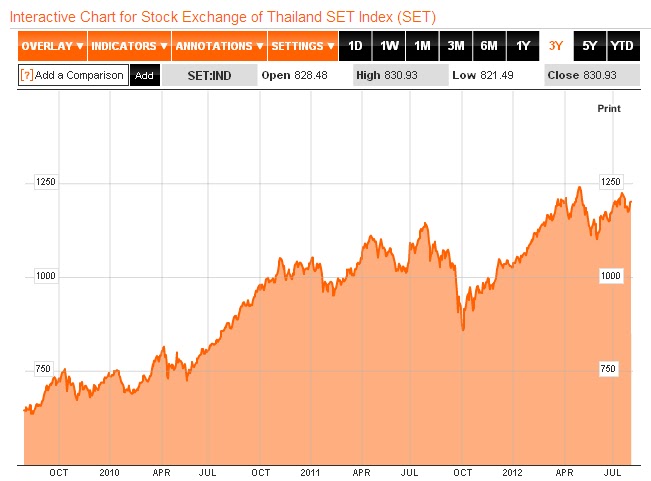
On a personal note, I have sold a decent part of my equity holdings, one example was a Thai Fund I bought in 2010 on a general recommendation of Marc Faber (I am a very happy subscriber of his Gloom, Boom & Doom newsletter), this is the Thai index over the last 3 years:
Sam Ro | Aug. 1, 2012
Goldman Sachs considers Korean trade data to be Asia's "canary in the coal mine" due to its high correlation to economic activity in mainland Asia.
Unfortunately, the canary is looking sick.
South Korean July exports plunged 8.8 percent from a year ago. Economists surveyed by Bloomberg were looking for a decline of 3.7 percent.
This disappointing number comes as global PMI data shows that deterioration in the world's manufacturing sectors.
Jim O'Neill, Chairman of Goldman Sachs Asset Management has previously argued that PMI and South Korean trade data were among the most reliable economic indicators in the world.
So, there's not much good news coming from the Asian economies. At this point, it seems the data is increasingly justifying further easy monetary policy measures from local central banks.
Marc Faber warned about commodity prices looking weak, here is the 10 year Dow Jones UBS Commodity Index:
- A huge bubble developed between 2002 and 2008 (partly caused due to the irresponsible money printing)
- The severe global recession in 2008/2009
- The recovery in 2010/2011
- The clear recent weakness in the last year, 20% down from the top in April 2011. Not exactly what one would expect in a strong economy.
On a personal note, I have sold a decent part of my equity holdings, one example was a Thai Fund I bought in 2010 on a general recommendation of Marc Faber (I am a very happy subscriber of his Gloom, Boom & Doom newsletter), this is the Thai index over the last 3 years:
Sunday, 8 January 2012
Prof Datuk Mohamed Ariff on Malaysian issues
From The Star of January 7, 2012:
http://biz.thestar.com.my/news/story.asp?file=/2012/1/7/business/10163037&sec=business#13258964893981&if_height=744
Excellent observations from Prof Datuk Mohamed Ariff, can't agree more with them.
The seven most important questions, the remaining three (more personal) in the link above:
[1] What are the three most troubling economic issues facing Malaysia today, and how can we tackle them? Bulbir Singh, Seremban
Persistent and endemic fiscal imbalance, growing income disparity and overdependence on foreign workers top the list. Malaysia lacks fiscal discipline. In the last 54 years since Independence, Malaysia has had budget surplus only in 7 years. Fiscal prudence demands counter-cyclical fiscal policy with surplus in good times and deficit in lean times, which allows fiscal stimulus during economic downturns to be financed by the accumulated surpluses without borrowing. As this has not been the case with Malaysia, the nation's public debt has been growing. National debt has risen to RM430.2bil in the first quarter of 2011, roughly 55% of gross domestic product (GDP), up from 41% in 2008. To balance the books, the government must rein in its operating expenditure and introduce tax reforms. The government's reliance on oil and gas which accounts for about 40% of total revenue is simply untenable. Federal revenue growth has failed to keep pace with GDP growth, so much so that the revenue/GDP ratio has fallen to 22% from the 10-year average of 34%.
The growing income disparity is also worrisome. The bottom 40% of the households account for only 14% of national income, while the top 20% of the households account for roughly 50% of aggregate income. Income inequality in Malaysia hovers at levels higher than that in Indonesia, the Philippines and Thailand. Regional disparity is equally striking. Sabah is the poorest with 20% of the households living below the poverty line. Sabah accounts for 43% of the country's poor, trailed by Sarawak (12%) and Kedah (9%). These three states jointly account for nearly two-thirds of the poverty in the country. To fix the problem, the government must revisit and review its affirmative action plans so that the benefits accrue directly to the poor and the marginalised, regardless of ethnicity.
While one must thank foreign workers for their contributions to the economic growth and development of the country, their numbers have grown far beyond “optimal” level. This overdependence on guest workers has contributed to the middle-income trap, as their over-presence tends to suppress wages. In the early 1990s, it was thought that Malaysia could stay competitive internationally by keeping wages low and hence the opening of the floodgates to foreign workers. Experience has shown that such input-driven growth is unsustainable. High wages backed by high productivity can translate into low labour costs. Malaysia needs to ensure that the locals have the necessary skills as the economy moves up the value-chain.
[2] Are all the measures we have put in place sufficient to ensure that we become a developed nation by 2020? What are we not doing right, if any? Abu Hassan, Petaling Jaya
The long-term Vision 2020 was both laudable and feasible. It was like running a marathon. The mistake we made was to run it like a sprint at maximum speed right from the start, pursuing input-driven high growth single-mindedly. In the process, we seem to have fallen unwittingly into the middle-income trap. We needed to grow only at 7% per annum to be a developed nation by 2020, and there was no need to grow at overheating double-digit pace. Malaysia's potential growth rate has fallen from 7% in the early 1990s to roughly 5% now. We need to raise our growth potentials by reinventing the economy. We need to move away from low value-added to high value-added activities, but this is easier said than done. It calls for bold policy reforms which may not sit well with vested interests that support and benefit from the current order.
[3] What is your opinion on the Economic Transformation Programme (ETP), Government Transformation Programme (GTP) and all the other transformation programmes? Reuban John, Klang
The various transformation programmes including the ETP and GTP are significant steps in the right direction. Much however would depend on their implementation. Besides, as the saying goes, the proof of the pudding is in the eating. Experience has shown that such programmes tend to work well if they are perceived to be bottom-up, not top-down. To reinvent the Malaysian economy, what we need is a holistic, not selective, transformation. In any case, change should be gradual, for “big bang” can be disruptive.
[4] What do we need to do most in order to stem the brain drain in the country? Li Ming, Johor
Brain drain need not be seen negatively in the first place. I once heard someone quip “brain drain is better than brain stuck in the drain.” It can play a positive role by creating a diaspora with pivotal international connectivity which is equivalent to gaining offshore economic space generating income inflows for the home country. The flip side, however, is that it deprives the nation of skills much needed to transform the economy. To stem the brain drain, we need to identify the root causes and tackle them effectively. Brain drain can be due primarily to the pull factor or the push factor. If it is the former, little can be done as it is purely external, but if it is the latter, it can be fixed domestically. We need to create lucrative job opportunities with levelled playing fields at home and eliminate the disincentives that encourage skilled personnel to exit. A reasonably liberal environment can be a powerful plus factor. A strong domestic currency would also discourage brain drain, just as a weak home currency would do exactly the opposite.
[5] Do you think that Malaysia is really losing its competitiveness to other countries in the region and what can we do to stop this? James Chin, Petaling Jaya
This is an empirical question. Empirical evidence is not conclusive, although the various competitiveness indices that rank countries provide some pointers. However, there are concerns over Malaysia's declining growth rates, with newly emerging economies in the region exhibiting greater dynamism. It is quite normal for emerging economies like Vietnam to grow faster than mature economies like Malaysia, due mainly to what economists call the base effect. Malaysia is still fairly competitive as shown by the seemingly perennial surplus in the balance of payments, but no country can afford to rest on the laurels. Latin American experiences are telling. Malaysia has huge potentials which are waiting to be unlocked through real policy reforms that would allow greater economic freedom to unleash the forces of transformation. It is unfortunate that politics tends to override economics.
[6] Is it really a big concern that our top universities command poor rankings in the international arena and what had contributed to this in the first place? Lily Raj, Penang
This indeed is a big concern, but we cannot blame it all on the universities as they partly inherit the problems from secondary and primary schools. Our education system is somewhat archaic with rote learning taking primacy over creativity and thinking. Nothing short of a complete overhaul can fix the problem. In short, we need to democratise our education system, but no one in the corridors of power has the gumption to get it done.
[7] What do you hope to see happen in Malaysia next year? Susan Cheung, Kuala Lumpur
I am afraid that we need to brace ourselves for a rough ride in 2012. Malaysia's exports are likely to face strong head winds, with several European economies shrinking and other developed economies stagnating, compounded by a sedated slowdown in China. The prices of major commodities, including gold, are likely to melt. The silver line is the window for real reforms as tough times will force politics to take the back seat. Hopefully, economic necessity will knock out political expediency.
http://biz.thestar.com.my/news/story.asp?file=/2012/1/7/business/10163037&sec=business#13258964893981&if_height=744
Excellent observations from Prof Datuk Mohamed Ariff, can't agree more with them.
The seven most important questions, the remaining three (more personal) in the link above:
[1] What are the three most troubling economic issues facing Malaysia today, and how can we tackle them? Bulbir Singh, Seremban
Persistent and endemic fiscal imbalance, growing income disparity and overdependence on foreign workers top the list. Malaysia lacks fiscal discipline. In the last 54 years since Independence, Malaysia has had budget surplus only in 7 years. Fiscal prudence demands counter-cyclical fiscal policy with surplus in good times and deficit in lean times, which allows fiscal stimulus during economic downturns to be financed by the accumulated surpluses without borrowing. As this has not been the case with Malaysia, the nation's public debt has been growing. National debt has risen to RM430.2bil in the first quarter of 2011, roughly 55% of gross domestic product (GDP), up from 41% in 2008. To balance the books, the government must rein in its operating expenditure and introduce tax reforms. The government's reliance on oil and gas which accounts for about 40% of total revenue is simply untenable. Federal revenue growth has failed to keep pace with GDP growth, so much so that the revenue/GDP ratio has fallen to 22% from the 10-year average of 34%.
The growing income disparity is also worrisome. The bottom 40% of the households account for only 14% of national income, while the top 20% of the households account for roughly 50% of aggregate income. Income inequality in Malaysia hovers at levels higher than that in Indonesia, the Philippines and Thailand. Regional disparity is equally striking. Sabah is the poorest with 20% of the households living below the poverty line. Sabah accounts for 43% of the country's poor, trailed by Sarawak (12%) and Kedah (9%). These three states jointly account for nearly two-thirds of the poverty in the country. To fix the problem, the government must revisit and review its affirmative action plans so that the benefits accrue directly to the poor and the marginalised, regardless of ethnicity.
While one must thank foreign workers for their contributions to the economic growth and development of the country, their numbers have grown far beyond “optimal” level. This overdependence on guest workers has contributed to the middle-income trap, as their over-presence tends to suppress wages. In the early 1990s, it was thought that Malaysia could stay competitive internationally by keeping wages low and hence the opening of the floodgates to foreign workers. Experience has shown that such input-driven growth is unsustainable. High wages backed by high productivity can translate into low labour costs. Malaysia needs to ensure that the locals have the necessary skills as the economy moves up the value-chain.
[2] Are all the measures we have put in place sufficient to ensure that we become a developed nation by 2020? What are we not doing right, if any? Abu Hassan, Petaling Jaya
The long-term Vision 2020 was both laudable and feasible. It was like running a marathon. The mistake we made was to run it like a sprint at maximum speed right from the start, pursuing input-driven high growth single-mindedly. In the process, we seem to have fallen unwittingly into the middle-income trap. We needed to grow only at 7% per annum to be a developed nation by 2020, and there was no need to grow at overheating double-digit pace. Malaysia's potential growth rate has fallen from 7% in the early 1990s to roughly 5% now. We need to raise our growth potentials by reinventing the economy. We need to move away from low value-added to high value-added activities, but this is easier said than done. It calls for bold policy reforms which may not sit well with vested interests that support and benefit from the current order.
[3] What is your opinion on the Economic Transformation Programme (ETP), Government Transformation Programme (GTP) and all the other transformation programmes? Reuban John, Klang
The various transformation programmes including the ETP and GTP are significant steps in the right direction. Much however would depend on their implementation. Besides, as the saying goes, the proof of the pudding is in the eating. Experience has shown that such programmes tend to work well if they are perceived to be bottom-up, not top-down. To reinvent the Malaysian economy, what we need is a holistic, not selective, transformation. In any case, change should be gradual, for “big bang” can be disruptive.
[4] What do we need to do most in order to stem the brain drain in the country? Li Ming, Johor
Brain drain need not be seen negatively in the first place. I once heard someone quip “brain drain is better than brain stuck in the drain.” It can play a positive role by creating a diaspora with pivotal international connectivity which is equivalent to gaining offshore economic space generating income inflows for the home country. The flip side, however, is that it deprives the nation of skills much needed to transform the economy. To stem the brain drain, we need to identify the root causes and tackle them effectively. Brain drain can be due primarily to the pull factor or the push factor. If it is the former, little can be done as it is purely external, but if it is the latter, it can be fixed domestically. We need to create lucrative job opportunities with levelled playing fields at home and eliminate the disincentives that encourage skilled personnel to exit. A reasonably liberal environment can be a powerful plus factor. A strong domestic currency would also discourage brain drain, just as a weak home currency would do exactly the opposite.
[5] Do you think that Malaysia is really losing its competitiveness to other countries in the region and what can we do to stop this? James Chin, Petaling Jaya
This is an empirical question. Empirical evidence is not conclusive, although the various competitiveness indices that rank countries provide some pointers. However, there are concerns over Malaysia's declining growth rates, with newly emerging economies in the region exhibiting greater dynamism. It is quite normal for emerging economies like Vietnam to grow faster than mature economies like Malaysia, due mainly to what economists call the base effect. Malaysia is still fairly competitive as shown by the seemingly perennial surplus in the balance of payments, but no country can afford to rest on the laurels. Latin American experiences are telling. Malaysia has huge potentials which are waiting to be unlocked through real policy reforms that would allow greater economic freedom to unleash the forces of transformation. It is unfortunate that politics tends to override economics.
[6] Is it really a big concern that our top universities command poor rankings in the international arena and what had contributed to this in the first place? Lily Raj, Penang
This indeed is a big concern, but we cannot blame it all on the universities as they partly inherit the problems from secondary and primary schools. Our education system is somewhat archaic with rote learning taking primacy over creativity and thinking. Nothing short of a complete overhaul can fix the problem. In short, we need to democratise our education system, but no one in the corridors of power has the gumption to get it done.
[7] What do you hope to see happen in Malaysia next year? Susan Cheung, Kuala Lumpur
I am afraid that we need to brace ourselves for a rough ride in 2012. Malaysia's exports are likely to face strong head winds, with several European economies shrinking and other developed economies stagnating, compounded by a sedated slowdown in China. The prices of major commodities, including gold, are likely to melt. The silver line is the window for real reforms as tough times will force politics to take the back seat. Hopefully, economic necessity will knock out political expediency.
Subscribe to:
Comments (Atom)