Showing posts with label Noble Group. Show all posts

Wednesday, 29 November 2017

Noble: overstating Yancoal's value? (2)

I have written several times about Noble Group, and in particular the "attacks" made by Iceberg Research.

My attention was drawn to the "strange" valuation of the valuation of its shares in Yancoal, I wrote:

  • Noble owns 13% of their shares;
  • Yancoal is listed and the 13% of the market cap is worth about $11M;
  • Yet the investment is in the books of Noble for $614M;
  • Noble doesn't seem to have significant control over the company
That looks very weird, to put it mildly.


Iceberg has written an open letter to Noble Groups's creditors, one snippet:


You suffered losses because a small group of people inside Noble and its auditor, EY, intentionally misrepresented the balance sheet and the performance of this company. For instance, an associate, Yancoal, was overvalued by $480m or 48 times. A few weeks ago, Noble finally capitulated, recognising the impairment.


The authorities should really look into this, that old valuation of $614M looks very, very wrong. That valuation was approved by the board of directors and the external auditors, surely shareholders and creditors based their investment decisions on this kind of information.

Wednesday, 17 May 2017

Noble group, its bonds and more

I wrote a few times about Noble Group, but nothing recently. I was interested in the case because of the strange valuation of its holding in Yancoal. That valuation seemed way of the mark (needless to say, DCF was used, the weapon of choice for these kind of occasions). The logical follow-up question would be, if the same would apply to some of its other assets?

Its share price has since come down quite a bit, and more worrisome (recently) the price of its bonds.

"The Macro Tourist" wrote an interesting article about Noble "Was Noble the silver seller?".

It describes a possible involvement of Noble with silver. It is a speculative assumption, but it does show a few nice charts.

Saturday, 18 June 2016

Noble Group, an overview

Great article in The Financial Times about Noble Group (I wrote several articles about them in the past):

Commodities: Noble’s House of woe

Some snippets:


Today the market value of the company — which is listed in Singapore — has collapsed to $1.1bn, its chief executive has left, and Mr Elman, 76, has announced he will step down as executive chairman in the next 12 months. In February, it reported annual losses for the first time in more than 20 years after taking $1.2bn in writedowns and charges, largely related to the value of long-term contracts it has been accused of overstating by short sellers, hedge funds and a former employee turned financial blogger.

Noble, which acts as a middleman for oil, coal, iron ore and metals deals, is now tapping its shareholders for $500m of cash and trying to sell prized assets in its efforts to pay down debt and free up capital for its trading operations.


“Noble compounded its problems with aggressive accounting,” says Craig Pirrong, a finance professor at the University of Houston who has written on the industry for Trafigura. “The accounting issues took a big toll on management’s credibility, and that made it very difficult to climb out of the hole.”


Mounting debts and high costs began to weigh on the company as bets in niche markets such as carbon credits backfired. As a listed company, it wanted smoother earnings to keep the stock market happy, former employees say.

Noble did this by recognising upfront a portion of gains from long-term marketing and supply agreements and recording their value on its balance sheet, say ex-employees. This technique, while legal under accounting rules, has seen only limited use among Noble’s rivals who say it is risky because the volatility of commodity prices means the amount of cash eventually received from the deals can be lower than the recorded profits.


Noble's 5-year price chart:


Saturday, 9 January 2016

Rating agencies are mostly useless

I have written about rating agencies before, in not too positive terms, being hopelessly slow and conflicted.

Standard & Poor's has added further to this impression by downgrading Noble Group's rating to junk only now:


"S&P lowered Noble Group’s rating to BB+ from BBB- and placed it on watch for further possible downgrade, the ratings company said in a statement on Thursday, following a similar move by Moody’s Investors Service in late December. Noble’s dollar bonds due in 2020 dropped to a record low of 54.78 cents on the dollar, according to prices compiled by Bloomberg."


Iceberg Research, the company that started to roll the ball in this case almost one full year ago, wrote this about the downgrade:


S&P has downgraded Noble Group to junk today, following a similar move by Moody’s.

The downgrade validates one of our main arguments against Noble: this company has never been investment grade. In fact, the question is why did it take so long when it was clear that Noble has been bleeding cash for years, and after we showed that profitability was supported by dubious mark-to-market?

The decision will have an important impact on Noble’s liquidity and the perception of its creditors. This further complicates the refinancing of its debt. Noble’s annual results will soon be audited and we doubt that this time, EY will take more legal risks when they sign off on the accounts.

The financial manipulations were conducted to artificially preserve the investment grade rating. The accounting illusion is now over. With a share price down 71% since our first report, and strong doubts over the balance sheet, Noble is facing an even more acute crisis. The group is slowly moving toward bankruptcy.

Most of our arguments on Noble’s accounting have already become facts. This management has completely lost credibility. It is urgent for Noble’s stakeholders to replace Mr. Elman and Mr. Alireza before the company sinks with them.

Friday, 21 August 2015

Silverlake Axis down 24%, suspended, after damning report

Trading in Singapore listed, Malaysia based, software solution provider Silverlake Axis was halted today after the share plunged 24%, as reported by The Edge.

The reason for the plunge and the trading halt is the following anonymous report:

"The Unbelievable Financial Alchemy of Silverlake Axis"

It is a rather comprehensive report with quite a lot of detail. I leave it to the readers to draw their own conclusions.

A bit more background about the company and its founder can be found in two recent articles in The Star, here and here. From the last article, one worrisome sentence:


"But investors find it hard to comprehend technology-based companies and even in the region, where Singapore-listed Silverlake Axis has a S$3.19bil market capitalisation, and where the bulk of its business derives from, many do not understand the company."


What now is needed from Silverlake Axis is a comprehensive, blow-by-blow, answer on all allegations in a very short time, preferably over the weekend. A flat denial, a superfluous answer or an attempt to shoot the messenger will simply not do (I guess Noble Group will agree with that, they have tried them all before).

Silverlake Axis should also be able to come up with a quick answer since this report does not come as a surprise. Rumours have been flying regarding this company for quite some time (I was aware of them), witnessed for instance by this article or this posting. In other words, the company was warned and should be prepared.

For Malaysia, it is another blow to its decreasing credibility.

First of all, there are simply too many scandals recently.

Secondly, corruption (one of the country's largest problems) is mentioned in the report as a possibility:


The corruption is not actually proven (that would be very hard to do for an outsider), but in the main report itself there is clearly more detail given than the above.

Saturday, 20 June 2015

GMT on AirAsia: "New Dog, Old Tricks"

On Vimeo a video is released giving some (but not all) of the issues that GMT Research has raised on AirAsia.

The video can be found here.

It is reasonably detailed and I recommend the viewer to pause the image when numbers are being shown.

Tony Fernandes has immediately described the report as "rubbish", and that he will proof the writers of the report wrong. Not an unexpected reaction.

However, what is needed is a more sophisticated reaction, not the kind of reaction from Nobel (listed in Singapore).

Airasia has announced a pretty decent reply a few days ago, however, there are some shortcomings.

First of all it prides it self on transparency, but good transparency is something else than good governance or good accounting.

For good governance for instance a neat corporate structure is needed, something AirAsia (and its mother company) doesn't have. The amount of related party transaction between the many parties (each with different shareholders) is simply overwhelming.

Regarding the good accounting: AirAsia has always accounted very aggressively, in my opinion much too aggressively, and in AirAsia X's case to an extent that is doesn't make sense at all (deferred tax when it continues to make losses).


Regarding the first part (the consolidation has just not been possible), surely it could have been presented in some form or shape in the year report, what the consequences would be of consolidating.

Good however that from the second quarter onwards the company will include the numbers.

For me, AirAsia has always relied much too much on a combination of financial engineering and marketing hyphe, something I don't like at all.

This report by GMT is a refreshing, different approach from the usual stuff we normally read in the Malaysian media.

Who will be right at the end of the day? I guess we have to wait and see.

AirAsia is however warned, and could thus take appropriate actions, for instance by raising more capital.

Another unrelated but interesting video by GMT can be found here, some of its contents:

  • WorldCom & Enron explained
  • Goodwill & impairments
  • CP ALL: A very over-leveraged buyout
  • Youku: Growth through acquisitions
  • Curious Assets
  • Wilmar: Leveraged Chinese carry trade
  • Reliance Infrastructure: Capitalising expenses?
  • Chinese Concessionaires: Paper profits
  • P&G H&H: Corporate governance
  • Larsen & Toubro: Cutting off the lifeline

Sunday, 31 May 2015

Issues regarding INEDs

From the last newsletter of MSWG:


... the Malaysian Code on Corporate Governance 2012 (the Code) recommends a 9-year term limit for INEDs (Independent Non-executive Directors) and the Listing Requirements makes reference to this recommendation where the companies must either comply or explain.

The Code provides under Recommendation 3.3 that there must be strong justifications for the board of a PLC to retain as an INED a person who has served in that capacity for more than 9 years. Also, the prior approval of shareholders is required to be sought.

Over the last 3 years, since the introduction of the Code in June 2012, we observed that the following have been practised:

  • INEDs tenure limit of 9 years have been exceeded sometimes as long as 20 or 30 years.
  • INEDs have been re-elected over the limit without strong justifications.
  • No resolutions were proposed for re-elections.
  • Multiple number of INEDs who have exceeded the limit were being put up for re-election simultaneously.

Focus Malaysia wrote an article (partially behind paywall) about the same matter: "Firms don’t fully comply with governance code".

My opinion, for what it is worth:

  • Asking Board of Directors to give a justification about the independence of a director whose tenure limit exceeds 9 years is akin to asking companies if their Corporate Governance is any good: both will result in useless, self serving statements.
  • With 55% of the listed companies on Bursa having INEDs with a tenure of more than 9 years, the obvious conclusion is that voluntary measures don't work. If the regulators want to be serious about this rule then they should simply enforce it. INEDs who are deemed to be useful to a listed company can still stay on, but as an non-independent director.

David Webb wrote "Principles of Responsible Regulation", one snippet:


As a result of the prevalence of controlling shareholders, investors large and small are usually minority shareholders, and if they are to have any real influence in the ordinary decision-making of companies, then they should have proper representation in the form of truly independent directors in the board room. But they don't.

Under HK listing rules, a so-called "Independent Non-Executive Director" is only as independent as the controlling shareholder wants him (or occasionally her) to be, because the controller gets to vote on the elections in general meetings. The result is often a sham system of illusory checks and balances where rubber stamps fill the required 3 seats on the board (or 1/3, whichever is greater) and form the committees that are supposed to monitor the executive management of the company.


And his recommendation:


"Independent directors should be elected by independent shareholders; any shareholder or the board can nominate candidates, but controlling shareholders must abstain from voting."


Webb's other recommendations also appear to be highly relevant in the Malaysian situation, with the exception of the second (Malaysia does have quarterly reporting).


On another matter, not only INEDs have an important role to perform versus minority shareholders, external auditors also.

Michael Dee wrote an open letter to the employees of Noble Group, his third recommendation being:


" ..... speaking of the now extinct Lehman Brothers, change your auditor, E&Y, who have been auditing Noble’s finances for 20 years now.

This is far, far too long. Auditors are guardians for investors and 20 years breeds too cozy a relationship. E&Y were Lehman’s auditor along with other infamous companies now defunct.

Noble says they rotate E&Y partners every five years but this is just substituting players on the same team. Your management have said E&Y doesn’t have to defend your financials, however they should defend their role in singing off on them.

Here it is instructive to review two aspects of E&Y which are relevant to establishing how much trust one should have in their work. First, as Lehman’s auditor they signed off on the earlier mentioned Repo 105.

Since then, it must be noted, E&Y has paid US$109 million in fines and penalties relating to their Lehman auditing work, including $10 million just recently paid to NY State over their role in the Lehman collapse.

“Auditors will be held accountable when they violate the law, just as they are supposed to hold the companies they audit accountable,” said New York Attorney General Eric Schneiderman.

The Public Companies Accounting Oversight Board (PCAOB), an accounting watchdog established by the US Congress has recently issued scathing comments about E&Y.

As reported by the WSJ in 2012 and 2013 the PCAOB found in their review of over 100 audits that they were deficient about 50 percent of the time.

In half of the audits reviewed, “E&Y hadn’t obtained enough evidence to support its audit opinions giving its clients a clean bill of health“ as reported in the WSJ last year.

But this isn’t a recent problem, the WSJ also reported in 2011 that in over half of the E&Y deficient audits it was because “E&Y was deficient in its testing of how clients applied fair value to their hard-to-value securities”.

This is directly relevant to Iceberg’s charges. Also directly relevant is that in 2012 it was reported E&Y had paid a record US$2 million fine with the PCAOB Chairman saying; “These audit partners and E&Y — the company’s outside auditor for more than 20 years — failed to fulfill their bedrock responsibility”. Not a ringing endorsement I would say."


I think it would be a good idea if listed companies are forced to change auditor every say ten years. It would increase the chance that possible irregularities would be noticed, especially in cases where auditors have become "too cozy" to the companies they are auditing, or when their fees for non-audit related services have become too high.

Thursday, 30 April 2015

Shareholders can query external auditors at general meetings

The issue if shareholders can ask questions to the external auditors was raised in the (rather heated, but very interesting from a corporate governance point of view) debate in Singapore regarding Noble Group.

Mak Yuen Teen wrote a clear answer to that matter in the Business Times (Singapore). Some snippets:


External auditors are appointed by shareholders, their report is addressed to shareholders, and they have a fiduciary relationship with them. It would be odd if shareholders appoint external auditors who report to them, but cannot ask questions about how they did the work.

.....  there is not much point in having external auditors present at general meetings - and companies being charged for it - just for them to issue boilerplate responses.

For example, shareholders at the Noble AGM could have asked questions about how the external auditors arrived at their audit opinion, the appropriateness of the accounting policies and assumptions used by the company, and how they audited the investments in associate companies such as Yancoal and biological assets.

As a matter of decorum, shareholders should direct their questions about the external audit or about other matters through the chairman of the meeting. The chairman should provide the opportunity for the external auditors, committee chairmen and others to answer these questions as appropriate.


To all readers who visit AGMs/EGMs and have questions regarding accounting matters, please feel free to follow the above advice. I assume the rules are the same in Malaysia.

On a side note: I hope to have time in the future to comment on Noble, which might also be worthwhile in the Malaysian context: although no company on Bursa has yet been targeted by a "shortseller", one day that surely will happen, better to be prepared for it, both for regulators and companies.

Sunday, 1 March 2015

Berkshire Hathaway: 50 years of Value Investing

Berkshire Hathaway, the conglomerate managed by Warren Buffett and Charlie Munger, published its much anticipated 2014 year report. It is the 50th since Buffett took control of the company. A true monument of value investing.

At the end of the day, the only thing that counts is the long term returns, and they are extremely impressive:


Berkshire Hathaway always uses "marked to market" for listed securities despite their limitations, Maybulk and Noble might want to take note:


It is the hallmark of the great manager to admit mistakes, Buffett does not try to hide the mistake he made regarding Tesco, about which I wrote here and here.


The last three sentences are a proof of the amazing stock picking abilities of Buffett and Munger.

Reviews about the year report can be found at Fortune, Forbes and The New York Times.

Friday, 20 February 2015

Markets also need negative viewpoints

I normally quite like Bloomberg's articles, but find the following article not balanced enough:

"Anonymous Analysts Are Wreaking Havoc in the Asian Markets"

The headline is much too aggressive for my liking, the share price of two companies in SE Asia declining caused by negative reports is something else as Asian Markets turning into chaos.

The first paragraph:


"An anonymous researcher releases a report questioning the accounts of a publicly traded company. Investors catch wind of it and sell. The targeted firm denies the allegations, but by then the share-price damage is already done."


I have not yet met a single fraudulent company admitting its fraud at the first instance being confronted by a report. Since both honest and fraudulent companies will deny allegations, the denial itself contains therefore no news.

What could contain news is a detailed write-ups from companies in which they give a point-to-point rebuttal of all the allegations.

Even better, if companies had pre-empted events by providing a high degree of transparency to their shareholders. In Noble's case for instance there was unease for quite some time regarding the valuation of Yancoal, why had it not addressed that issue before? Valuing an asset at 56 times its market value is bound to raise some eyebrows.

Let's assume that short sellers are right in a particular case, then "the share-price damage is already done" is indeed true. But the damage is caused by unscrupulous managers and their financial engineers who have cooked the books, blown lots of hot air in the company, spread rumours etc. The short sellers have merely prevented more future damage (while in some cases profiting handsomely in the mean time, I admit).

Also, some of the allegations by so called short sellers or whistle blowers might need years to pan out. In 1999, financial analyst Harry Markopolos "informed the SEC that he believed it was legally and mathematically impossible to achieve the gains Madoff claimed to deliver". It took another nine years before the fraud was finally unravelled, lots of additional damage being done in those years.

A further comment from the Bloomberg article:

“No research should be anonymous,” said Jimmy Ho, president of the Society of Remisiers, Singapore’s biggest association of equity traders.

Whilst I agree that non-anonymous research would be better, I do have sympathy for the reasoning behind it:

Carson Block, the founder of Muddy Waters LLC, said in 2012 he stopped trying to bet against Chinese stocks after workers at a storage company he owns in Shanghai were harassed and unidentified “gangsters” came looking for him.

“Putting our name on the reports gave us more credibility but I understand why people see a need to be anonymous when publishing this kind of information because of the threats and the costs of extra protection,” Block said in an interview on Tuesday in New York.

And:

...independent research reports can be beneficial for investors if they “weed out” companies that are bending accounting rules or engaging in fraudulent activity.

“I’m not concerned about the origins of the report, it’s whether the report is true, accurate and valid ultimately,” said Surtees, whose firm oversees about $50 billion. “Time will tell.”

Another comment by Mr. Ho:

“MAS should make sure analysts do not use their research for their own agenda.”

That also means that analysts (or brokers, bloggers or anyone spreading rumours to increase the share price of a certain company) who write positive reports for their own agenda (or the agenda of their company) should equally be punished. In that case government of all countries in the world should consider quickly building a few more jails for this purpose alone.

News on financial markets is rather biased, and all in a positive way for listed companies:
  • Managers have a real financial incentive (receiving wages but often also owning a stake in the company) to paint their companies as rosy as possible, they even hire PR companies for that purpose.
  • Brokers and the like receive their handsome fees through all kind of financial work for these companies (bringing them to the market, structuring deals, etc.), their research reports are often quite biased (just check how many "buy" reports there are versus "sell" reports). Even if brokers don't have a direct link to a company, they might be involved with one of the other companies of the majority shareholder.
  • Professionals like auditors and writers of independent reports too often have a bias towards the companies that pay them: "whose bread I eat, his song I sing".
  • Journalists are sometimes hesitant to post negative questions, their papers are sometimes biased towards companies that advertise (a recent example from the UK and the response containing the remarkable admission "All [media organisations] have their own self-serving agendas, both political and commercial"). 
  • Regulators should be on top of their game, but realistically they can't follow hundreds of companies and are not strong in particular fields (like valuations).

Despite all these shortcomings, I like the capital markets and am an active and passive (through external fund managers) participant for more than thirty years, both in listed and unlisted companies.

But giving the many biases, there is a clear and urgent need for views from "the other side", views that give critical analysis of companies, that question their accounts and their business models.

Therefore we have to be careful not to immediately jump on top of messengers of bad news.

The three cases mentioned in Bloomberg's article are:
  • Noble, in a report written by Iceberg Research, about which I wrote before;
  • Sound Global Ltd, in a report by Emerson;
  • Ozner Water, in a report by Glaucus.

Wednesday, 18 February 2015

Noble: overstating Yancoal's value?

"Iceberg Research", an unknown and anonymous website, has issued a negative report about Noble Group, the commodity trading company listed on the SGX.

For me, the most important is if the allegations are true and the most interesting item is the valuation of Yancoal in Noble's books:
  • Noble owns 13% of their shares;
  • Yancoal is listed and the 13% of the market cap is worth about $11M;
  • Yet the investment is in the books of Noble for $614M;
  • Noble doesn't seem to have significant control over the company.
That looks very weird, to put it mildly.

Macquarie writes:


"But the shares are thinly traded, which can distort market value. This is one reason why Noble can use a financial model, reviewed by auditors Ernst & Young, to value the stake. With sustained weak coal prices, we have been flagging the risk of further write downs for YAL (2012 carrying value: US$813m). The Noble CEO himself hinted at such a potential outcome at a recent sell side event. Whilst we do not see the full carrying value at risk, there could be a non-trivial impact vis-à-vis Noble’s S$0.98 BVPS (excluding perpetuals). But, again, we have been flagging this risk for well over a year."


Regular readers of this blog will know what I think about the many financial calculations (most of them DCF models) that are being used. Changing one single parameter would already later the outcome of the model hugely, but there are often many important parameters. The result is a very wide range of valuations (not a single valuation), the lowest of which has to be zero.

In other words, giving a single valuation through the use of these kind of models is (in most cases) useless, rubbish and self-serving.

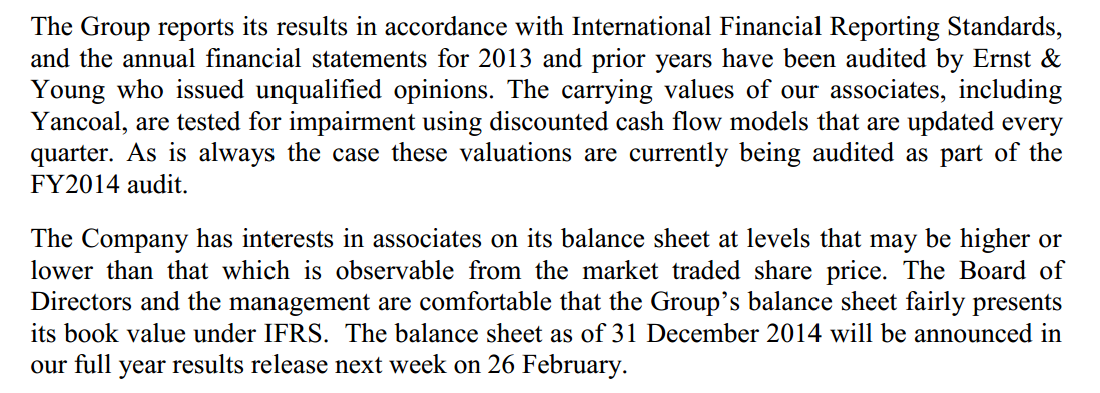
Noble has since responded, no surprises here:


If the DCF model of the stake in Yancoal does indeed indicate a valuation of $614M, 56 times as much as the current market price, then the company really should publish the model's assumptions and calculations, for all to see. We could then also check the model with the outcome say three years down the road.

Unfortunately, publishing the model's details hardly ever happens is my experience.

The Monetary Authority Singapore (MAS) is looking into the case, Noble's year report will be announced on February 26, 2015.