Below article is from Errol Oh from The Star, October 1, 2011. PNB's behavior regarding Asia File is indeed puzzling.
I have written in the past about what I would like to call "Government Linked Funds" (GLF's) like PNB, EPF, Valuecap, LTAT etc. They have been very disappointing in the last decades, they could have been vocal, they could have voted against controversial deals (especially Related Party Transactions), they chose to stay silent and toe the line. I am sure that if they had issued press releases in the past, announcing how they would vote and why, that newspapers would be more than happy to print their views.
They helped to initially fund MSWG, it looks like these GLF's found that that was enough for them, they let MSWG do the talking and stayed further passive.
I really hope their mentality will change soon; they are managing other people's money and thus have a huge responsibility. We are now Anno 2011, a world where people demand transparency; these GLF's should update their websites, give insights in their holdings, their voting behavior and their explanations for it, etc.
ON Wednesday, Permodalan Nasional Bhd (PNB) was a central player in two unrelated corporate developments. Of course, the top news of the day was the fund manager's general offer for shares in property developer SP Setia Bhd.
That alone warrants StarBizWeek today offering at least a cover feature and a comment piece. And there will surely be more coverage in the coming weeks as the story unfolds.
PNB's other headline-grabbing corporate manoeuvre on Wednesday was equally intriguing and surprising. At the AGM of stationery maker Asia File Corp Bhd, PNB voted against the reappointment of three independent directors and refused to approve the directors' fees of RM242,000 for financial year ended March 2011.
However, PNB didn't have enough votes to outnumber the ayes, and the resolutions went through. Although the state-owned company failed to change the outcome of the AGM, it certainly made a statement. Only thing is, what was it trying to say?
The Asia File management doesn't seem to know. A daily quoted executive chairman Lim Soon Huat as saying: “They (PNB) decided to request for a poll (to vote on the resolutions) without notifying us ahead of time and we were shocked. The reason given by the representatives who attended the shareholders' meeting was that their boss told them to vote like that.”
The same newspaper labelled PNB's move at the Asia File meeting as “a rare display of shareholder activism”, but that's stretching things a bit.
It's not the first time that shareholders act mysteriously and without warning when there's no indication of any dispute at shareholder or boardroom level during general meetings to block the passage of routine resolutions, such as the re-election of directors.
For example, during the AGM of Chemical Company of Malaysia Bhd (CCM) in April 2003, the voting on the 11 resolutions were by way of poll. Three were not carried, including the resolution to re-elect group executive director Oh Kim Sun, who had been slated to take over as CCM's managing director in October that year. The identity of the shareholder who voted against the resolutions wasn't made public.
There were similar instances last year at the AGMs of Envair Holdings Bhd, Industronics Bhd, Seacera Tiles Bhd and Nakamichi Corp Bhd, when plain vanilla resolutions were defeated. Are these cases of shareholder activism at work too? We don't know the answer because the shareholders concerned haven't come forward to say why they were against the resolutions.
It's a good time to revisit the concept of shareholder activism. For one thing, it takes more than showing up at a shareholders' meeting and blind-siding everybody by silently opposing resolutions.
Instead, it ought to involve active engagement with the relevant parties (the board and management, and other shareholders and stakeholders) to bring about changes in a company's policies and actions. Usually, it's about pressuring company executives, and that requires using the media and mobilising public opinion.
The February 1999 Report on Corporate Governance by the High-Level Finance Committee on Corporate Governance refers to shareholder activism by institutional investors in the context of “demanding and pursuing higher corporate governance standards”.
The Securities Commission's (SC) Corporate Governance Blueprint 2011, issued in July, brings an updated perspective on this topic, plus a deeper discussion. In recommending the formulation of a code for institutional investors, the document says such a step can strengthen the accountability of institutional investors to their own members and investors.
“Responsible ownership requires high standards of transparency, probity and care on the part of the institutions, which may be met by adhering to a set of over-arching principles in the form of a code for institutional investors. There is a need for institutional investors to review their existing practices in the light of growing recognition of the significance of their role and heightened expectations to monitor management and moderate managerial discretion,” adds the SC in the blueprint.
“The new code will require institutional investors to explain how corporate governance has been adopted as an investment criteria and the measures they have taken to influence, guide and monitor investee companies. It is also important for institutional investors to include governance analysis in their investment appraisal to help identify better governed companies.”
The plan is for institutional investors in Malaysia to form a working group to draw up the code. The blueprint lists some areas in which there should be best practices to be incorporated in the code. No.1 is “Commitment to engagement”.
“The code for institutional investors must address the issue of transparency with regard to institutional investors and their agents' commitment to meaningful engagements and whether such engagement policies are effectively implemented,” says the SC.
Hopefully, we don't have to wait long for the code. It tickles the imagination to speculate on the motives behind the strange goings-on at AGMs and EGMs, but people don't invest based on amusement value. It's far better that we work towards having true shareholder activism, when ownership rights are exercised openly and responsibly.
Monday, 3 October 2011


Sunday, 2 October 2011
Maybulk: before and after POSH
These are the pictures from Maybulks 2007 year report:


Profits and earnings were rising nicely and even shareholders equity was going up despite paying large dividends. It can't get much better than that. This was the company I liked so much that I invested in. A good part of the profits was from selling vessels, but this was almost recurring in nature, Maybulk seemed to be very skilled in it.
This is the share price chart until the announcement of POSH:

It reached a high of RM 5.40, it had come down since then due to the global economic outlook. Also there were worries about oversupply for tankers and bulk carriers. On the other hand, Maybulk would go into the recession with more than RM 1,400,000,000 in cash and short term deposits (September 30, 2008), not many companies on the Bursa Malaysia would be in such a sweet spot. Surely the management of Maybulk would use the money wisely?
But then, out of the blue, the company announced the controversial POSH deal, and things would never be the same again for Maybulks shareholders.
From the 2010 year report:
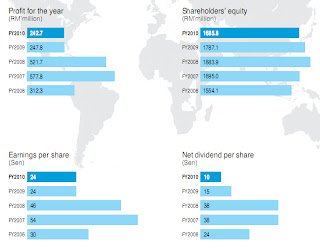
Profits down and dividend cut from 38ct to a paltry 10ct a share. Revenue and profit for the first half of 2011 would be 26% and 10% down and the investment in POSH had worked out badly.
From Ze Moola's website "Maybulk: Does poor corporate governance have a negative impact on a stock?":
http://whereiszemoola.blogspot.com/2011/09/maybulk-does-poor-corporate-governance.html
Ze Moola stressed that Maybulk had bought listed securities in the past without disclosing details. I agree that companies should disclose this important information. In Maybulk's case it involved amounts larger than RM 100 million, why do shareholders get a detailed list of all properties and vessels, but not of the listed companies it invested in? Also, if companies don't need the cash it should consider distributing it in the form of dividends to the shareholders.
This is the 3 year chart comparing Maybulks share price with the CI from Ze Moola's website:

An amount of RM 100 invested in a basket of CI shares would be worth about RM 135, the same amount invested in Maybulk shares only RM 70, in other words Maybulk has underperformed by a very large amount since the announcement of the POSH deal.
We can see from the above graph that Maybulk initially held up quite well. Looking at the changes of shareholding of the Bursa Malaysia website it seems that EPF was (almost) solely responsible for that. On the day the POSH deal was first announced (September 15, 2008) EPF owned 56 million shares. Surprisingly, EPF must have liked the deal a lot, since it kept on buying Maybulk shares until February 2010 when it owned 83 million shares. Apparently they changed their mind about Maybulk since they have been net seller ever since, their current holding is 72 million shares.
To me it is a mystery why an organization like EPF bought 27,000,000 shares in a company with a large controversial Related Party Transaction as described in the previous blogs about Maybulk. And then, finally, changed its mind and started to sell 11,000,000 shares in the open market.
Maybulk announced another related party transaction occurred in 2009:
"Malaysian Bulk Carriers Berhad (“MBC” or “the Company”) wishes to announce that its subsidiary, Ambi Shipping Pte Ltd (”Ambi Shipping”) has signed a Memorandum of Agreement dated 25 September 2009 to acquire a vessel, Ikan Juara, from Juara Shipping Pte Ltd (“Juara Shipping”) for a cash consideration of USD23.75 million. This is a related party transaction as Juara Shipping is itself a wholly-owned subsidiary of Pacific Carriers Limited (“PCL”), a major shareholder of MBC."
But Maybulk didn't want to disclose for which price it bought the vessel for, and thus also not the profit it had made on it:
"Pursuant to a confidentiality agreement between the lessor and the lessee (PCL Group), the original cost of investment cannot be disclosed."
I urged the authorities (Securities Commission and/or Bursa Malaysia) to pursue this matter, not having to disclose the original cost of investment would mean that related party transactions can not be properly checked by minority shareholders.
For the benefit of the readers I will reveal the original cost here: USD 17,608,071. In other words, PCL booked a profit of USD 6.14 million or about RM 21,300,000. Not bad since PCL only bought the vessel two months before.
I retrieved the above information from the ACRA website in Singapore at a fee. Why was this (publicly available) information not revealed to the shareholders of Maybulk, and why did Bursa Malaysia not want to press this issue further? Should all shareholders have to go through the hassle of finding out where this information can be found?


Profits and earnings were rising nicely and even shareholders equity was going up despite paying large dividends. It can't get much better than that. This was the company I liked so much that I invested in. A good part of the profits was from selling vessels, but this was almost recurring in nature, Maybulk seemed to be very skilled in it.
This is the share price chart until the announcement of POSH:

It reached a high of RM 5.40, it had come down since then due to the global economic outlook. Also there were worries about oversupply for tankers and bulk carriers. On the other hand, Maybulk would go into the recession with more than RM 1,400,000,000 in cash and short term deposits (September 30, 2008), not many companies on the Bursa Malaysia would be in such a sweet spot. Surely the management of Maybulk would use the money wisely?
But then, out of the blue, the company announced the controversial POSH deal, and things would never be the same again for Maybulks shareholders.
From the 2010 year report:

Profits down and dividend cut from 38ct to a paltry 10ct a share. Revenue and profit for the first half of 2011 would be 26% and 10% down and the investment in POSH had worked out badly.
From Ze Moola's website "Maybulk: Does poor corporate governance have a negative impact on a stock?":
http://whereiszemoola.blogspot.com/2011/09/maybulk-does-poor-corporate-governance.html
Ze Moola stressed that Maybulk had bought listed securities in the past without disclosing details. I agree that companies should disclose this important information. In Maybulk's case it involved amounts larger than RM 100 million, why do shareholders get a detailed list of all properties and vessels, but not of the listed companies it invested in? Also, if companies don't need the cash it should consider distributing it in the form of dividends to the shareholders.
This is the 3 year chart comparing Maybulks share price with the CI from Ze Moola's website:

An amount of RM 100 invested in a basket of CI shares would be worth about RM 135, the same amount invested in Maybulk shares only RM 70, in other words Maybulk has underperformed by a very large amount since the announcement of the POSH deal.
We can see from the above graph that Maybulk initially held up quite well. Looking at the changes of shareholding of the Bursa Malaysia website it seems that EPF was (almost) solely responsible for that. On the day the POSH deal was first announced (September 15, 2008) EPF owned 56 million shares. Surprisingly, EPF must have liked the deal a lot, since it kept on buying Maybulk shares until February 2010 when it owned 83 million shares. Apparently they changed their mind about Maybulk since they have been net seller ever since, their current holding is 72 million shares.
To me it is a mystery why an organization like EPF bought 27,000,000 shares in a company with a large controversial Related Party Transaction as described in the previous blogs about Maybulk. And then, finally, changed its mind and started to sell 11,000,000 shares in the open market.
Maybulk announced another related party transaction occurred in 2009:
"Malaysian Bulk Carriers Berhad (“MBC” or “the Company”) wishes to announce that its subsidiary, Ambi Shipping Pte Ltd (”Ambi Shipping”) has signed a Memorandum of Agreement dated 25 September 2009 to acquire a vessel, Ikan Juara, from Juara Shipping Pte Ltd (“Juara Shipping”) for a cash consideration of USD23.75 million. This is a related party transaction as Juara Shipping is itself a wholly-owned subsidiary of Pacific Carriers Limited (“PCL”), a major shareholder of MBC."
But Maybulk didn't want to disclose for which price it bought the vessel for, and thus also not the profit it had made on it:
"Pursuant to a confidentiality agreement between the lessor and the lessee (PCL Group), the original cost of investment cannot be disclosed."
I urged the authorities (Securities Commission and/or Bursa Malaysia) to pursue this matter, not having to disclose the original cost of investment would mean that related party transactions can not be properly checked by minority shareholders.
For the benefit of the readers I will reveal the original cost here: USD 17,608,071. In other words, PCL booked a profit of USD 6.14 million or about RM 21,300,000. Not bad since PCL only bought the vessel two months before.
I retrieved the above information from the ACRA website in Singapore at a fee. Why was this (publicly available) information not revealed to the shareholders of Maybulk, and why did Bursa Malaysia not want to press this issue further? Should all shareholders have to go through the hassle of finding out where this information can be found?
Saturday, 1 October 2011
E&O Minority Shareholders grill the Managing Director
Good: "The six-hour meeting started with minority shareholders taking the chance to grill E&O managing director Datuk Terry Tham Ka Hon on his share sale with Sime Darby Bhd."
Bad: "Generally, many minority shareholders as well as MSWG were not satisfied with the replies given to the questions raised at the meeting"
Bad: "The media was not allowed to enter the meeting" (authorities really should try to do something about this, either by changing the rules or putting more pressure on companies to allow the press to attend AGM's or EGM's)
Strange: "why ECM Libra decided to seek representation on the board" (only holding 6.4% of the shares)
Strange: "Sime Darby has not nominated any representation to the board" (holding 30% of the shares)
Disappointing: the long time that the Securities Commission needs for its decisions (but these are tough decisions and I am hoping for not only good and fair decisions but also the reasoning behind them for future cases)
Disappointing: that the big players in this saga hardly ever mention the rights or the plight of the Minority Shareholders, the mentality Anno 2011 is scary to say the least. There are luckily many companies in Malaysia with a better attitude, the way the Board of Directors of SP Setia reacted on PNB's offer is just one example.
The Saga continues .....
http://www.btimes.com.my/Current_News/BTIMES/articles/EOREJ-2/Article/index_html
Bad: "Generally, many minority shareholders as well as MSWG were not satisfied with the replies given to the questions raised at the meeting"
Bad: "The media was not allowed to enter the meeting" (authorities really should try to do something about this, either by changing the rules or putting more pressure on companies to allow the press to attend AGM's or EGM's)
Strange: "why ECM Libra decided to seek representation on the board" (only holding 6.4% of the shares)
Strange: "Sime Darby has not nominated any representation to the board" (holding 30% of the shares)
Disappointing: the long time that the Securities Commission needs for its decisions (but these are tough decisions and I am hoping for not only good and fair decisions but also the reasoning behind them for future cases)
Disappointing: that the big players in this saga hardly ever mention the rights or the plight of the Minority Shareholders, the mentality Anno 2011 is scary to say the least. There are luckily many companies in Malaysia with a better attitude, the way the Board of Directors of SP Setia reacted on PNB's offer is just one example.
The Saga continues .....
http://www.btimes.com.my/Current_News/BTIMES/articles/EOREJ-2/Article/index_html
Chaoda: insider trading?

Possible insider trading, shares are suspended, annual results will be delayed (a breach of the Listing Rules), all sounds not very good. Below two articles, from BusinessInsider and BusinessWeek.
http://www.businessinsider.com/george-stairs-2011-09-30
http://www.businessweek.com/news/2011-09-30/chaoda-says-chairman-kwok-disputes-tribunal-allegations.html
Chaoda’s shares were suspended from trading on Sept. 26, the same day the misconduct proceedings were first reported. They’ll remain suspended until the company issues a statement to address a report by Anonymous Analytics, it said. The report questions Chaoda’s accounts.
Chaoda will delay releasing its annual results for the year ending June 30, which were expected today, to “include additional audit procedures” after reports from the media and Anonymous Analytics, the company said in a filing to the Hong Kong Stock Exchange today.
Subscribe to:
Posts (Atom)