Sunday, 25 February 2018

"Hibiscus - the story of a succesful SPAC"?

Article in The Star, one snippet:


"Hibiscus should not only be applauded for being the first SPAC, but also a successful one."


I have been rather sceptical in the past about SPACs in general and Hibuscus was no exception.

Below is the share graph since inception, it shows a rather wildly fluctuating price, from initial RM 0.59 to RM 2.68 crashing down to RM 0.16 and up to its current price of RM 0.98. A rather bumpy ride for a stock that was perceived to be rather speculative.


If we dive into the latest quarterly financials then we notice the following:


In other words, despite being listed for almost seven years and having received more than seven hundred million of shareholders capital, the company still has not shown a profit overall. That does not seem to be impressive, simply putting the money in a Fixed Deposit would have yielded something like RM 200 Million in interest payments.


One should also take note that three quarters of its assets consists of intangible assets. An investor should deep dive in the nature of these intangible assets to check if any of them should be revalued.

So is Hibiscus indeed a successful SPAC, as The Star wants us to believe? Looking at the results delivered so far the answer has to be negative.

Wednesday, 24 January 2018

Dual class shares: another really bad idea (4)

Article at Bloomberg's website:

Singapore Exchange Takes on Hong Kong With Dual-Class Shares

One snippet:


Singapore Exchange Ltd. said it allow companies with dual-class share structures to list, a month after Hong Kong announced a similar proposal, as competition between markets for technology listings becomes increasingly fierce.


Sigh. I think the SGX is making a mistake here: bending backwards in CG terms and complicating rules and legislations in the hope of getting large IPOs like Facebook or Alibaba to list in Singapore. I don't think that won't happen anyhow (SGX is simply not attractive enough at the moment).

A critical article:

SGX's Doubly Bad Idea

Even in the unlikely event that a company will IPO with dual class shares and the company will be a huge success operationally, the result might be limited. Makers of indices are considering leaving out companies with dual class shares, like the S&P 500:


"Farewell, Snap Inc (NYSE: SNAP), we hardly knew ye." That was the message from the Standard & Poor's 500 index on Tuesday, when it suddenly stopped allowing companies with dual-class share structures to join the index.


That means that most likely ETFs who follow indices on Singaporean, ASEAN, Emerging Markets or Global shares will not include companies listed on the SGX with a dual class structure.

Also, many active fund managers will frown upon these companies due to serious CG concerns.

The result would be that these companies trade at a sizeable discount to comparable companies with one class, and deservedly so.

Singapore has in the past actively encouraged mainland China companies to list on the SGX (the so called S-chips), is recently active in ICOs, soon allowing dual class shares and it might require less companies to issue quarterly reports. From a CG point of view, this all seems (very) worrisome.

What do we get next, a S-chip company with half yearly reporting having a dual class share structure issuing an ICO? The possibilities seem endless. But does this all really benefit the Singaporean economy in the long term? I strongly doubt it.

I have a lot of respect for the long term planning and execution in Singapore for instance regarding infrastructure, it is very impressive. But somehow this does not seem to apply to the financial markets.

Malaysia seems to have things better organized; it does not intend to allow dual class shares and issued a very clear warning regarding ICOs.

Monday, 22 January 2018

Debt has always been an efficient tool?


One snippet:


"DEBT has always been an efficient tool for finance and investment and it comes to no surprise that the list of companies that have the largest amount of debt includes some of the largest companies on Bursa Malaysia."


That is a rather remarkable statement in itself. 

I would therefore like to add some counterweight:

"Debt has also always been an efficient tool to bancrupt a company in the fastest possible way".

There are worldwide many, many examples of companies that used too much debt and did not live to tell the tale.

One reason for the increased risk of bancruptcy is that earnings are simply too low (or even negative) to sustain the debt payments.

Another reason is that despite having reasonable earnings a company might run into cashflow problems.

The stable of enterprises of Khazanah might have more options to increase debt even more (through Khazanah), but that might not always lead to the desired outcome and even increase the problem. MAS might be one example in this category.

Also, easier debt from a GLF like Khazanah might give a company a possibly unfair advantage over its privately funded rivals.

An example of a heavily indebted company outside the Khazanah stable is 1MDB, a story that most likely will end very costly for the Malaysian taxpayers.

Wednesday, 13 December 2017

Maxwells Mysterious Marketing (5)

The company announced:


" .... Beijing Taojin Law Office had on 11 December 2017 tendered their resignation due to the difficulty faced by Beijing Taojin Law Office in conducting the due diligence in relation to the litigations investigation such as (i) the Courts had not been cooperative; and (ii) the number of court cases and the amounts claimed cannot be conclusively determined yet at this juncture.

In view of Beijing Taojin Law Office’s resignation, the subsidiaries of the Company, Jinjiang Zhenxing Shoes & Plastic Co. Ltd and Maxwell (Xiamen) Co. Ltd, have appointed Guangdong Kingbridge Law Firm in the People’s Republic of China, who are familiar with Guangdong and Fujian provinces area legal matters, to conduct special due diligence on the litigations investigations involving the subsidiary of MAXWELL.


Guangdong Kingbridge Law Firm will also conduct special due diligence on the cash deposits placed with the asset management company and Maxwell (Xiamen) Co. Ltd’s advertisement expenses.
The Company has requested Guangdong Kingbridge Law Firm to issue the special due diligence legal opinion report by middle of January 2018."


This is a case that is dragging on for more than two years. Shareholders should not expect to get the clarity that is very much needed suddenly in one month time.

Monday, 11 December 2017

Sapura Energy "eking out profits in the majority of quarters"?

Article in The Star "Blip for Sapura Energy", one snippet:


"The stock ..... has been eking out profits in the majority of quarters since the collapse of crude oil prices in late 2014 ......"


Strictly speaking, this is correct, the majority of the quarters were indeed positive.

But ..... overall the company has bled a lot of money over those same quarteres since the losses were much larger than the profits.

The exact amount of the losses over the last 11 quarters is RM 800,000,000.00.

That is a lot of money and that would describe the current situation of Sapura Energy much better than "eking out profits in the majority of quarters". Good journalists should perform this kind of checks to give a more balanced picture.

Other interesting facts that are not revealed in the article are the total amount of liabilities of Sapura Energy (RM 22 Billion) versus only RM 1.9 Billion cash, and the rather high rewards for the controlling shareholder while the company is bleeding money.

Thursday, 30 November 2017

Maxwell: what does Mdm Li know?

I have written several times about Maxwell International, not in a very positive way, to put it mildly.

The company announced its quarterly results and again the revenue was exactly RM 0.00.

Optimists will say that it can't get much worse than that.

According to the balance sheet, the asset value per share is RM 1.00, mostly backed by cash.

The share price is lingering around RM 0.02.

So apparently not many people believe the balance sheet. I can't blame them for that.

Mdm Li, President and major shareholder, disposed of 20 Million shares at a price of RM 0.02 each.

Does she not believe the balance sheet either? If the cash is real, then surely the company can distribute it to the shareholders, who would hugely gain from it. And Mdm Li, as the controlling shareholder, can set that process in motion.

So why does she sell her shares, what does she know?

This is one of several China based companies listed on Bursa where the regulators should have acted in a decisive manner a long time ago.


Raine & Horne: was their punishment sufficient?

I wrote six years ago: "Are SC's administrative actions a real deterrent?".

The relevant punishment by the SC can be found here.


In March of this year I wrote "Land value increased 10 times in 3 years?"

One snippet:

  • Boustead Plantations proposes to sell a piece of land for RM 620.1 Million based on a valuation report by Raine & Horne dated December 1, 2016.
  • The land was acquired for only RM 60.4 Million three years earlier based on a valuation report by WTW dated September 5, 2013.
  • The difference in valuation is more than ten times over only three years, which seems shocking.


One snippet:


"The Malaysian Anti-Corruption Commission (MACC) has arrested two former real estate executives as part of its investigation into Felda investment Corporation's (FIC) purchase of the four-star Kensington Hotel in London.
MACC in a statement today said the duo were arrested at 1pm when they presented themselves at the MACC headquarters to give their statement.

"Based on the investigation, the two were suspected of manipulating the hotel price (valuation) resulting in FIC overpaying tens of millions," it said.

MACC said when the purchase of the hotel was underway between 2013 and 2015, the two served as chief corporate adviser and director respectively at the real estate agency Raine and Home."

Most likely the writer means Raine and Horne (not Home), a valuer that has also done many valuations regarding property owned by Bursa listed companies, so I assume that Bursa and the SC will follow this case with interest. If the allegations of the above deal are true, then other valuations done by the same people might have to be reviewed as well.


Today an article was published on Malaykini's website: "Valuer defends A$43m valuation for Mara’s UniLodge".

Two snippets:


A Malaysian-based chartered surveyor and valuer hired by Mara Incorporated Sdn Bhd (Mara Inc) to assess the price of the UniLodge building in Australia in 2012, has defended its allegedly inflated A$43 million (about RM133 million) valuation.

Raine & Horne International Zaki + Partners executive director Rosli Atan told Malaysiakini he was “confident” that the survey conducted five years ago was carried out according to the proper methods.

On Aug 28, 2012, based on the A$43 million valuation of UniLodge by Raine & Horne, Mara Inc paid A$41.8 million to purchase “all interests” in a BVI company called Thrushcross Ltd, despite that the company did not legally own the building at that time.

Rosli’s valuation report was an annexure to the sale and purchase agreement of Thrushcross. The seller was Scarlett Nominees Limited, another BVI-registered company.

The UniLodge valuation raised a red flag as Thrushcross eventually bought the building five months later for only A$23.5 million – a whopping A$19.5 million lower than Raine & Horne’s appraisal.


I am sure that the reader noticed the common link in all of the above articles.

Of course, a party is innocent until proven guilty. 

That brings me back to my original article written six years ago. I wrote, referring to the administrative actions (mostly reprimands) taken by the SC:


Is there any deterrent in these kind of punishments?

Wednesday, 29 November 2017

Noble: overstating Yancoal's value? (2)

I have written several times about Noble Group, and in particular the "attacks" made by Iceberg Research.

My attention was drawn to the "strange" valuation of the valuation of its shares in Yancoal, I wrote:

  • Noble owns 13% of their shares;
  • Yancoal is listed and the 13% of the market cap is worth about $11M;
  • Yet the investment is in the books of Noble for $614M;
  • Noble doesn't seem to have significant control over the company
That looks very weird, to put it mildly.


Iceberg has written an open letter to Noble Groups's creditors, one snippet:


You suffered losses because a small group of people inside Noble and its auditor, EY, intentionally misrepresented the balance sheet and the performance of this company. For instance, an associate, Yancoal, was overvalued by $480m or 48 times. A few weeks ago, Noble finally capitulated, recognising the impairment.


The authorities should really look into this, that old valuation of $614M looks very, very wrong. That valuation was approved by the board of directors and the external auditors, surely shareholders and creditors based their investment decisions on this kind of information.

Monday, 27 November 2017

China Stationary, unable to contact the 2 remaining directors

Today China Stationary announced the suspension of its shares.

It also announced:


 ..... that the Company is unable to release its Third Quarter Results by 30 November 2017 (“Timeframe”) to Bursa Securities as required under Paragraph 9.22(1) of the MMLR.

The failure to issue the above Third Quarter Results is due to the following reasons:


1. unable to obtain confirmations from third parties (i.e. bankers, debtors, creditors, courts in China etc) to perform verification checks in relation to all litigation cases involving the subsidiaries of CSL;


2. unable to contact the two remaining directors i.e. Mr Chan Fung @ Kwan Wing Yin and Mr Angus Kwan Chun Jut. Hence, no Board of Directors' meeting is held to approve the Third Quarter Results; and


3. unable to undertake the necessary assessment on the impact to the CSL’s financial statements and its operations without the issuance of legal opinion report by Zhi Jun Law Firm of Fujian.


What a joke!

Except of course if you are an investor in this company, in which case you probably have not read this blog.

To rub further salt in the wound, the company accounts were approved until the very end, year 2016:


And according to these numbers the company still had more than RMB 1.8 Billion (!) cash.

That is, if one would actually believe these numbers, the auditor (RT LLP from Singapore)  apparently did so, I don't.

Bursa did indeed issue a directive, which included:


(b)     Verification of CSL’s existing cash and bank balances ....


Unfortunately, much too late, they should have done this many years ago. This company had so many red flags that I lost count.

I hope that Bursa and SC learn from this case and will issue the same directive to all China listed companies. The bad apples will fail, while the good ones (if any) will gain from this exercise.

Will there be any justice in this case? I hope so, but it might be rather difficult, the company is listed in Malaysia, incorporated in Bermuda, has operations and assets in China and its auditors are Singaporean. Good luck with that!

Insider trading, why the differences in punishment? (2)

I received the trading data of APLI during the time the insider trading.


Three snippets from the article on the SC website:

  • Thai was convicted for communicating non-public information between 26 October 2007 and 29 October 2007 to Tiong
  • APLI made announcements to Bursa Malaysia Securities Bhd about the audit adjustments and its classification as a PN 17 company on 31 October 2007
  • Tiong was convicted for two counts of disposing a total of 6,208,500 APLI shares while in possession of the same non-public information

If the announcement was made on October 31 2007, then the share price would have been impacted on the following trading date, November 1, 2007.

The relevant closing prices of APLI on those days are:
  • October 26, 2007: RM 0.39
  • October 29, 2007: RM 0.40
  • November 1, 2007: RM 0.31

So if Tiong sold 6,208,500 on October 26 and/or October 29 instead of November 1 (when the news was available to all parties), then the price difference is in the order of 6,208,500 times about RM 0.09, or about RM 560,000.

Compared to the sentences (5 years jail and RM 5 Million fine for Thai) that looks like a surprisingly small amount.

Just to put it in perspective, I suspected insider trading in Proton shares (see link) and wrote:


EPF sold about 15 million shares of Proton, for a price clearly below the MGO price. If the buyers of these shares were trading with insider information, then EPF was disadvantaged for an amount of roughly RM 20-30 million on those trades.


And that was just one party (EPF) possibly (hugely) disadvantaged in just one suspected insider trading case in Malaysia. I am pretty sure I can come up with dozens of similar suspicious insider trading cases, if not more.

According to this article in The Edge, Thai's lawyers "have advised that there are sufficient grounds to appeal on the conviction. As to the sentence, his lawyers have also filed an appeal on the grounds that it is manifestly excessive."

The "wonderful" world of QE (2)

From Michael Lewitt's latest letter, quoted on this website:


Anyone questioning whether financial markets are in a bubble should consider what we witnessed in 2017:
  • A painting (which may be fake) sold for $450 million.
  • Bitcoin (which may be worthless) soared nearly 700% from $952 to ~$8000.
  • The Bank of Japan and the European Central Bank bought $2 trillion of assets.
  • Global debt rose above $225 trillion to more than 324% of global GDP.
  • US corporations sold a record $1.75 trillion in bonds.
  • European high-yield bonds traded at a yield under 2%.
  • Argentina, a serial defaulter, sold 100-year bonds in an oversubscribed offer.
  • Illinois, hopelessly insolvent, sold 3.75% bonds to bondholders fighting for allocations.
  • Global stock market capitalization skyrocketed by $15 trillion to over $85 trillion and a record 113% of global GDP.
  • The market cap of the FANGs increased by more than $1 trillion.
  • S&P 500 volatility dropped to 50-year lows and Treasury volatility to 30-year lows.
  • Money-losing Tesla Inc. sold 5% bonds with no covenants as it burned $4+ billion in cash and produced very few cars.

Sunday, 26 November 2017

Insider trading, why the differences in punishment?

From the SC website:

Ex-CEO of APL Industries Bhd and Ex-Remisier Fined and Jailed Five Years for Insider Trading


The Kuala Lumpur Sessions Court today convicted former CEO of APL Industries Bhd (APLI), Stanley Thai Kim Sim, and former remisier Tiong Kiong Choon for insider trading offences. Thai was sentenced to a five-year jail term and a RM5 million fine, while Tiong was sentenced to five years jail and a RM10 million fine.

Insider trading offences, under section 188 of the Capital Markets and Services Act 2007 (CMSA), carry a mandatory punishment of imprisonment not exceeding 10 years and a fine of not less than RM1 million.


Thai was convicted for communicating non-public information between 26 October 2007 and 29 October 2007 to Tiong. Tiong was convicted for two counts of disposing a total of 6,208,500 APLI shares while in possession of the same non-public information via accounts belonging to his mother-in-law and his mother. At the time of the commission of the offence, Tiong was also a licensed intra-day trader with a stock broking company.


The non-public information communicated from Thai to Tiong related to the audit adjustments proposed by APLI’s auditors which resulted in APLI reporting a higher loss for the financial year ended 30 June 2007, as compared to the previously reported unaudited Q4 results for the same financial year, and that APLI would be classified as a PN 17 company. APLI made announcements to Bursa Malaysia Securities Bhd about the audit adjustments and its classification as a PN 17 company on 31 October 2007.


In passing the sentence, Sessions Court judge Tuan Zulqarnain Hassan ruled that a deterrent sentence was warranted as insider trading offences were deemed more serious than conventional crimes, given far reaching effects on investors’ confidence and the public as a whole. “Insider trading is a modern white-collar economic crime. It is serious and is in a category or class of its own,” said the learned judge.


The conviction came after a full trial where 14 witnesses testified for the Prosecution while four witnesses testified for the defence.


This blog has always been in favour of enforcement, which has been so much lacking in Malaysia, especially in white-collar crime. However, punishment has to be consistent.

Many cases of insider trading have been settled for three times the profit without admitting guilt.

This bags the question: which factors played a role in the above case compared to other cases that explain the huge difference in punishment?

On another matter, the events happened ten years ago, can the legal process please be done faster?

Insider trading is a serious crime with real victims, the investors who were not privy to the inside information. Those victims should be able to come forward and claim what is due to them. But who can remember what happened such a long time ago? Most people will have discarded their trading statements after some years.

Friday, 24 November 2017

AirAsia X 2017 Q3 provision

AirAsia X released its 3rd quarter 2017 results and the following press release.

One snippet:


“The Company did well operationally in 3Q17. However, the third quarter financial performance was set back by the one-off provision for doubtful debt of RM50.2 million. It is a necessary action that has to be taken as we move on from past management’s business decisions.  With the observed booking trends, we are in line with expectations for a recovery in the 4Q17."


RM 50.2 Million is a lot of money, Air Asia X should give more details regarding this provision for the benefit of its shareholders. The AirAsia group loves to bring positive news to the media in a big way, but seems rather "hesitant" when the news is bad.

Also, blaming the past management is not exactly "elegant". Was the Board of Directors aware of the issue at hand? If yes, then they might also have to bare part of the brunt. If not, why were they not informed?

Sunday, 12 November 2017

Sime Darby: what happened after its merger? (2)

Long article in The Star: Sizing up Sime Darby’s demerger

But what is missing?

First of all one simple number, how much will this demerger actually cost? Surely this number should have been disclosed in a transparent manner.

The previous exercise in which Sime Darby was merged with Golden Hope and Kumpulan Guthrie was rumoured to have cost RM 500 Million, that is a lot of money. Most likely this demerger will cost a similar amount of money. This cost is certain to happen, possible benefits are just projections, there is a large difference between a certain cost and possible future benefits.

Secondly, were the expectations of that previous merger met? According to this link:


Were those annual benefits of RM 400 - 475 Million ever realized? I strongly doubt it, Sime Darby's results have been disappointing since the merger. But would it not be better to analyze first what went wrong the last decade, and communicate these findings in a transparent way to the shareholders?

Thirdly, if this demerger really makes so much sense, why was it not done ten years earlier, when the merger took place? It could have saved hundreds of millions of fees and costs with the company having the possible benefits over the last decade.

Monday, 6 November 2017

China Ouhua: red wine and red flags (5)

I have written several times before about China Ouhua Winery, and not exactly in "glowing terms". To be more exact, I haven't found a single positive aspect regarding this company.

I was therefore rather surprised when I noticed the following:


According to the website of The Edge, Fundamental Score is defined as:


The Fundamental Score is a snapshot of a company’s fundamental strength, derived from historical numbers. For those who are not familiar with financial jargons, we have condensed some of the most often-used ratios into this "Score" to reflect a company’s profitability and balance sheet strength.

The Fundamental Score ranges from 0 to 3 for easy understanding. A score of 0 means weak fundamentals and a score of 3 means strong fundamentals.


The definition of the Valuation Score is as follows:


If you are unfamiliar with financial jargons, we have condensed several of the most-often used valuation benchmarks into a Valuation Score of 0 to 3 – to determine if a stock is attractively valued or not, at this point in time.

A Valuation Score of 0 means valuations are not attractive. Vice versa, a score of 3 means valuations are attractive.


That means that China Ouhua has a fundamental strength (1.80) that is better than average and a somewhat attractive valuation (0.90).

Somewhere in the database and/or algorithms of The Edge, something must have gone horribly wrong.

Surely both the fundamental and valuation score for China Ouhua have to be 0.00.

For more background on the company and to get a flavour what this company is about (hint: managing the winery is not exacty their forte), please check the previous articles.

Saturday, 4 November 2017

Bots can give "annual returns of over 40 percent" ......?

There is a lot going on in the fintech world and while I am hesitant about certain directions (I am definitely not convinced about digital currencies like bitcoin), I do agree that I might simply be wrong (some would say: "too old to understand this").

One new direction of fintech is regarding robot programs that place automatically trades based on programs provided and certain parameters that the user chooses. My eye caught the following announcement on TechInAsia's website:


Robo-investor AlgoMerchant begins trading after $2m-plus funding

Everyman securities trading platform AlgoMerchant will officially launch this month after raising more than US$2 million in funding from East Ventures and a “network of prominent individuals in the fund management and broking industry.”

The Singapore-based startup offers a range of robo-traders that allow investors of all shades – from part-time retail investors to professionals and high-net-worth individuals – to automate securities trading through their personal trading accounts.


The robo-traders use data analytics and machine learning tech to automate trading, while also avoiding delays and human error. The basic service is free, while a range of premium packages can be paid for.


AlgoMerchant said it collaborates with freelance quantitative traders  – in other words, those that specialize in automated trading – and data scientists from around the world to discover profitable investment algorithms. More than 1,000 traders tested out the service during its nine-month beta phase.


So far so good, it definitely sounds interesting.

But I almost dropped out of my chair when I read the following:


Forty percent returns

The startup claims that its bots can give everyday retail investors “an edge similar to resource-rich top quantitative hedge funds,” securing projected annual returns of over 40 percent.


Annual, consistent returns of over 40 percent are simply from another world. Even Warren Buffets returns would pale in comparison to those.

Just as an example, $ 10,000 would turn into $ 8,360,000 over 20 years using 40 percent returns. I guess we all would love that, it would for instance solve all pension problems of the world.

But worrisome, there is no basis whatsoever given in the article for these kind of returns, it looks like they are plucked from the sky.

On the company's website the only thing I can find regarding returns is this:


The majority of retail investors’ portfolios follow the returns of the market. AlgoMerchant’s strategies, however, are alpha-seeking and target upwards of 20% per annum.


Suddenly the "over 40 percent returns" has changed into "upwards of 20% per annum".

Following the same example, $ 10,000 would turn over 20 years into $ 383,000.

Not bad at all, but a rather far cry from the $ 8,360,000 based on 40% returns.

The graph supporting these claims is as follows:


Two obervations:

  • The starting point of any simulation is very important. In this case the company used January 1, 2008, in other words exactly at the start of the global recession. Thirteen months later equity markets are down 47%, the company claims Paladin (their algorithm) would theoretically be up by 45%, a huge outperformance by all means in a rather short while. But that crisis is a "one in a generation" event, it is very tricky to start a simulation exactly there.
  • After the crisis, the central banks started the largest financial "experiment" (QE, quantitative easing) ever, driving interest rates down to a level not seen in 5,000 years. Again, the question is, how would Paladin have theoretically performed under more "normal" circumstances?

My guess is that these hypothetical results are derived from optimising on the data itself, causing over optimisation (especially given the rather unique circumstances of the last ten years), and thus generating much too rosy projections of future returns.

Friday, 3 November 2017

Sapura Energy: excessive remuneration for Directors? (3)

Article in The Star: Sapura Energy tumbles on Mokhzani’s exit

One snippet:


Shares of Sapura Energy Bhd tumbled more than 9% in early Thursday trade following report that Tan Sri Mokhzani Mahathir is disposing off his entire stake in oil and gas services company.

This is the second time Mokhzani is offloading its stake in an oil and gas firm. In 2015, Mokhzani’s private vehicle, Khasera Baru Sdn Bhd sold off a block of 190.3 million shares in SapuraKencana Petroleum Bhd for close to RM820mil in total.

Industry players said Mokhzani’s exit did not come as a surprise. They added that Mokhzani believed the oil and gas industry was a global issue and prefers to redeploy his resources in other investments.

Mokhzani through Khasera Baru has a 10.10% stake in Sapura Energy. 

According to a term sheet, Mokhzani is looking to sell up to RM905.1mil of Sapura Energy shares.

The bookbuilding range for the offer represents 605 million Sapura Energy shares was between RM1.42 and RM1.49 a share.

The price range represents an 8% to 12.3% discount to Sapura Energy’s closing price of RM1.62 on Wednesday ahead of the bookbuilding launch.

Khasera Baru will not own any Sapura Energy shares after the sale.


"Industry players" said "Mokhzani believed the oil and gas industry was a global issue and prefers to redeploy his resources in other investments".

May be, but could this (yearly renumeration of RM 84M, most likely by the CEO) or this (RM 70M yearly fees, most likely to a company linked to the same person) while the company was losing more than half a billion RM over the last two years have to do with it?

Also taking into consideration that two resolutions were voted against by 18% and 22% of the votes, rather unusual in the Malaysian context.

The sale is suprising given that the share price is roughly at its lowest point of the last five years. Why would anybody want to sell now, especially since it looks like the price of oil has turned and oil inventories are running low?


I guess there is more to the story than "Mokhzani believing the oil and gas industry was a global issue".

Sunday, 29 October 2017

Hiap Teck untimely announcement by substantial shareholder

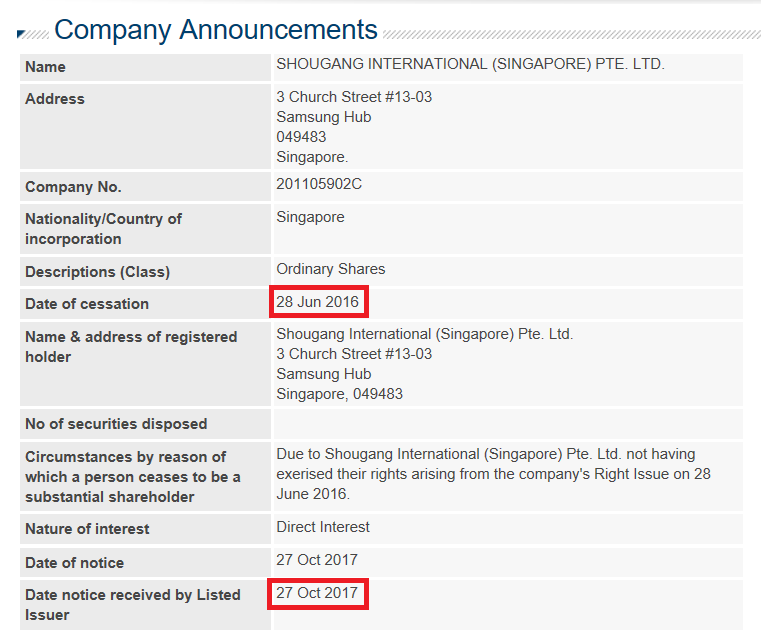
Hiap Teck made the following announcement:


One year and four months late, Shougang International gives a whole new meaning to the definition of "timely disclosure".

From the 2016 annual report:


Shougang International is still listed as a substantial shareholder, is that still correct?

I have written several times already about this issue, it should be relatively easy to automate these types of announcements regarding shareholding by directors and substantial shareholders. Why has that not yet happened?

Monday, 16 October 2017

CNLT, where is the enforcement?

From kehakiman's website regarding CNLT (Far East) Bhd, a company formerly listed on Bursa:


11. The Employees’ complaint of fraudulent trading straddled 8 allegations of fact that allegedly occurred between 2006 and 2008.  They were as follows:

(a) CNLT, primarily through its managing director, the Appellant, prepared or issued fictitious invoices in 2007 to an entity known as MTI (Far East) Sdn Bhd amounting to RM4,271,745.06 with a view to inflating or overstating its revenue, such that CNLT would appear to be a ‘going concern’, or at the very least, not as insolvent as it actually was;

(b) Overstating the value of the plant and machinery of CNLT;


(c) Siphoning of CNLT’s funds by way of payment of rental to Golden Privilege Sdn Bhd when there was no such tenancy agreement.  This company was controlled by the Appellant and the 7th defendant;

(d) CNLT’s assets in the sum of USD1,250,000 were dissipated or channelled to CNLT’s largest shareholder, JCT Limited, the 8th defendant after CNLT had been listed as a PN17 company;

(e)  CNLT, through inter alia, the Appellant caused 3 cheques in the sum of RM160,000.00 to be issued on 11 September 2007.  These cheques were encashed on 12 September 2007;

(f) Failure to cause CNLT to remit contribution to Employees Provident Fund (“EPF”) and Social Security Organization (SOCSO), both employer and employee despite deducting the requisite employee contribution since August 2007.  Neither was income tax paid, despite the requisite deductions having been made;

(g) The Appellant’s action in dissipating assets out of the reach of provisional liquidators in May 2008; and

(h) Payments were made out to preferred unsecured creditors, as well as some shareholders in the sum of not less than RM2,841,696.00 without validation at the time the restraining order dated 26.10.2007 was in force.


12. It was the Employees’ case that by reason of the foregoing matters the business of CNLT was carried on from 2006 onwards until it was wound up in January 2009 with intent to defraud creditors of the company, or for a fraudulent purpose.  For the purpose of the application of section 304 of the Act in this suit the creditors contemplated here were the Employees.


13. By this action, the Employees sought inter alia the following orders:

(a) a declaration that the business of CNLT had been carried on by the defendants with intent to defraud creditors of CNLT, in particular the Employees pursuant to section 304 of the Act;

(b) a declaration that the defendants shall be jointly and/or severally liable and personally responsible, without any limitation of liability for all of the debts or other liabilities of CNLT; and

(c) an order that the defendants, jointly and/or severally do pay the outstanding debt due and owing to the Employees by CNLT.


Very heavy accusations, and what did the judge decide?


18. At the end of the trial, the learned trial judge held that the Employees had proved 7 out of 8 allegations.  It was held that allegation (c), the siphoning of  CNLT’s funds by way of payment of rental to Golden Privelege Sdn Bhd, was not made out.  The learned trial judge found that payments to JCT limited were void as they were against the law prohibiting undue preference.

19. The learned trial judge accordingly held that the business of CNLT was carried on by the Appellant with intent to defraud the creditors of CNLT including the Employees pursuant to section 304 of the Act.  A declaration was made to that effect by the court.  There was however no such declaration granted in respect of the other directors of CNLT.  The court also held that the Appellant was personally liable to the Employees, to pay the Employees the sum of RM2,910,201.78 as claimed with interest.


Most of the proven allegations happened more than ten years ago.

A forensic report was made, with many observations similar to the above. The company however denied all in an announcement to Bursa. Since the judge held that seven allegations have been proved, the truthfulness of the contents of that announcement should be reviewed.

The above court case was a private affair by the employees who were disadvantaged. It seems they are winning their case, good for them, it must have been a quite costly and lengthy affair.

But what have the authorities done so far, for instance in regards to the minority investors who have been disadvantaged? From what I could find, not much.

Bursa reprimanded the company (I don't think anybody will be bothered by that) and delisted it (basically disadvantaging the minority investors by depriving them an opportunity to trade their shares). No action whatsoever was taken against any individual.

SSM obtained a conviction: "The Kuala Lumpur Sessions court today convicted Dato’ Prem Krishna Sahgal (‘Dato’ Prem’) for committing an offence under section 364 (2) of the Companies Act 1965. Dato’ Prem was sentenced to pay a fine of RM40,000.00 in default 6 months imprisonment."

It continues "SSM hopes the above decision will send out a clear message". I doubt that, I find the punishment very light, especially given the small chance of getting caught.

Where is the enforcement for any of the other (very serious) allegations, why have Bursa and/or SC still not taken any action in this matter?

Justice delayed is justice denied.

Friday, 13 October 2017

MUFG acquiring banks, but why sell CIMB?

Article from Bloomberg:

MUFG Seeks to Spend $900 Million on Acquisitions in U.S, Asia

One snippet:


Mitsubishi UFJ Financial Group Inc.’s lending arm is seeking acquisitions of about 100 billion yen ($890 million) in Asia and the U.S. to bolster its global operations, its top executive said.

Bank of Tokyo Mitsubishi UFJ Ltd., to be renamed MUFG Bank in April, would consider taking majority stakes in banks in countries such as Indonesia or India in addition to the U.S., Chief Executive Officer Kanetsugu Mike said in an interview. 

While Japan’s biggest bank has previously signaled interest in buying lenders in the countries, it’s the first time a senior executive has indicated how much it might spend. Mike, 60, said any decision would be based on strategic fit, price and profitability, while noting that U.S. targets are “expensive” at the moment.

Japan’s biggest banks are expanding abroad to make up for declining loan profitability and a shrinking population at home. In the U.S., MUFG owns a bank with a heavy presence in California, and is the largest shareholder in Morgan Stanley. It bought stakes in banks in the Philippines, Thailand and Vietnam in recent years.

Overseas business remains “a driver of growth for both the bank and the group,” Mike told a group of reporters at the lender’s Tokyo headquarters.


This seems like a rather clear intention, it wants to expand overseas by buying stakes in other banks.

But this is in rather stark contrast to MUFG selling its stake in CIMB only half a year ago, so why exactly did it do that?